NURS 6900: finding a pediatric preceptor for the UCCS FNP
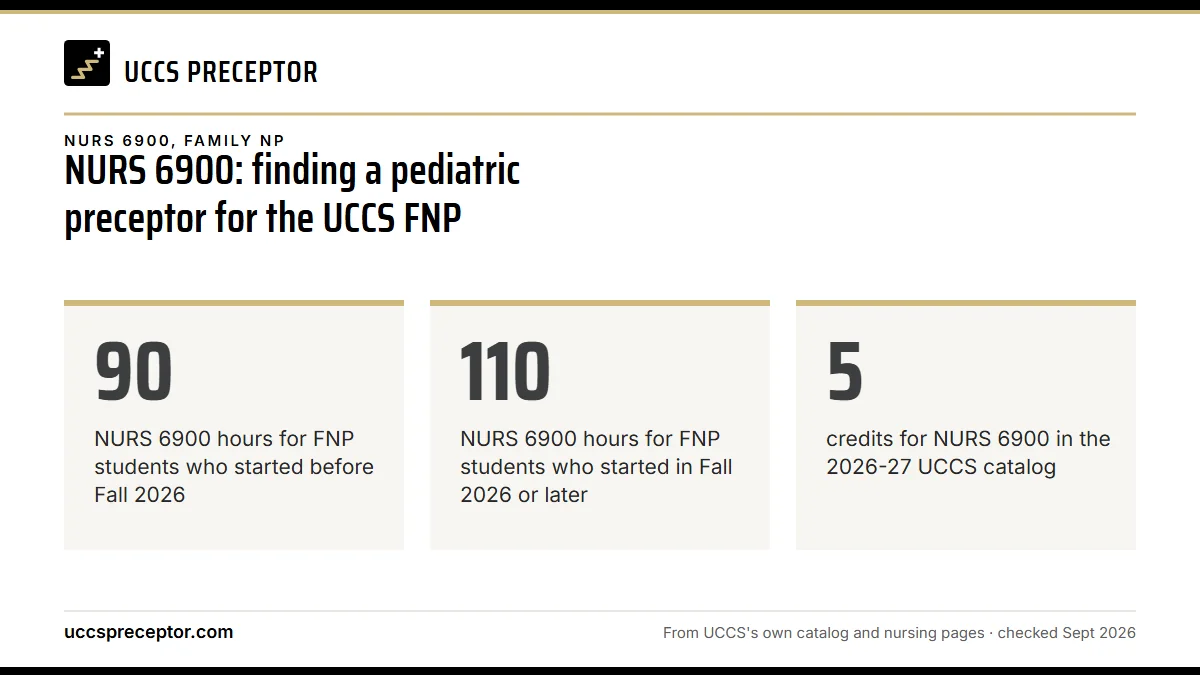
NURS 6900 Primary Care of Pediatric Patients and Families is the Family NP rotation centered on children: 90 hours if you started before Fall 2026, 110 if you started in Fall 2026 or later, all of it in outpatient primary care. It calls for a preceptor whose schedule is full of young patients, and that is the search our placement desk runs for UCCS FNP students where they live.
Find my pediatric preceptor
Share your state, start term and the semester your degree plan lists for NURS 6900.
Who takes NURS 6900, and when
NURS 6900 is a 5-credit course on the Family NP track only. Adult-Gerontology students take NURS 6950 in its place, and that swap is the single course that separates the two primary care tracks. FNP students in the RN to MSN, the BSN to DNP and the Family NP certificate take the same pediatric course, since the NP track is shared.
Like every population rotation, it requires the full 6000-level MSN core plus NURS 6730, NURS 6740 and NURS 6280. The catalog does not fix the order of the primary care courses, so pediatrics could be your first rotation or your third, and your degree plan decides. That position matters more than it looks: two handbook rules, the patient-log minimum and the urgent care allowance, depend on how far into the rotations you are. Synthesis cannot begin while NURS 6900 is incomplete.
NURS 6900 hours for each start term
Your start term, not the semester you sit the course, sets the figure. Students who began before Fall 2026 count 45 hours per practicum credit; Fall 2026 starts and later count 55.
| Start term | Hours in NURS 6900 | Weekly pace over 16 weeks (our arithmetic) | Patient-log minimum |
|---|---|---|---|
| Before Fall 2026 | 90 | about 5.5 to 6 | 75, 90 or 125, by course order |
| Fall 2026 or later | 110 | about 7 | 75, 90 or 125, by course order |
The handbook sets log minimums of 75 patients in your first clinical course, 90 in the second and 125 in the third; lead faculty confirm the figure for your sequence. If pediatrics lands third, 125 children in 90 hours means seeing well over one patient an hour, so the practice's volume matters. UCCS does not say whether NURS 6900 runs in the 8-week summer; if it did, 110 hours there would mean about 14 a week. Every visit goes into Medatrax with ICD-10, CPT and E/M codes, as the Medatrax guide explains.
What counts in a pediatric rotation
Pediatrics follows the same primary-care-only rule as every FNP rotation, with a few twists that apply to this course alone.
- Counts: outpatient pediatric offices, and family practices with a large share of children.
- Does not count: newborn nursery rounds, pediatric inpatient units or any other hospital work; the handbook bars hospital settings and hospital rounding.
- Does not count: an emergency department or ED fast-track.
- Not in this course: women's health hours, which can go in any rotation except
NURS 6900. - Not in this course: pediatric specialty clinics, which count only in Synthesis, up to 110 hours.
- Only if pediatrics is not your first rotation: urgent care, which the handbook opens from the second rotation onward.
- Limited: telehealth, capped at 45 hours for the entire program.
The FNP and AGNP counting rules set out each of these limits in full.
Plan your 30 to 45 women's health hours for a different course: the handbook keeps them out of NURS 6900.
The preceptor NURS 6900 needs
Any FNP-track preceptor type can take this course: an NP who is nationally certified with full prescriptive authority, an MD, a DO or a PA, licensed in the state where you do the hours and in practice for at least two years. For pediatrics that points to a pediatrician, a family physician with many young patients, a PA in a pediatric office, or an NP certified in family or pediatric care.
The real test is volume and mix. A family practice that sees children only now and then can leave you short on pediatric encounters, while a busy pediatric office can carry the whole rotation. At 90 or 110 hours, a single preceptor sits comfortably under the 330-hour limit UCCS places on one preceptor or site outside a major health system.
The usual restrictions hold: no relatives or close friends as preceptors, and no practice where you or a family member works. An employer's pediatric clinic is possible only at a different location or unit, with the Graduate Clinical Practicum Coordinator's approval.
Where to look for a pediatric preceptor
UCCS expects you to take part in the search and suggests beginning 3 to 6 months ahead. It cannot share lists of sites that already have agreements, though the Clinical Practicum Coordinator can be contacted for help. The handbook's own leads adapt well to pediatrics:
- Classmates who have finished
NURS 6900and know which offices take students. - Your local advanced practice group, where pediatric and family NPs meet.
- Nursing faculty at schools in your state, who may precept or know who does.
- Community health clinics and faith-based clinics that serve families.
Your preceptor must be licensed in the state where you do the hours, and that state must be on UCCS's list; see approved states. Some sites also require a myClinicalExchange account, which you register for and pay for once the college flags it. The finding your own preceptor guide covers the wider search.
Why FNP students hand us the NURS 6900 search
We treat the pediatric rotation as a search of its own. The placement desk contacts pediatric and family practices where you live, asks about their share of young patients before anything else, and confirms the preceptor's license, certification and two years of experience.
Once a preceptor agrees, we gather what the Clinical Site Sheet and UCCS's agreement process call for: names, credentials, license and certification details, the site's information, who can sign for the site, and an exact figure of 90 or 110 hours. UCCS reviews and approves; we make sure the college gets a complete, rule-ready file early.
If the office backs out, your placement advisor is already working on the next one. Start with the form below or read how it works.
Questions UCCS students ask
Do AGNP students take NURS 6900?
No. The Adult-Gerontology track swaps pediatrics for the geriatric rotation, NURS 6950, which carries the same 90 or 110 hours. Every other AGNP clinical course matches the FNP list, from NURS 6730 through Synthesis, so the two tracks differ by one rotation.
Can I split NURS 6900 between two preceptors?
Yes, if each is approved. UCCS wants one Clinical Site Sheet per site and per preceptor, each with an exact hour figure, and a second site may need its own Affiliation Agreement. Only three new agreements can be submitted per semester outside Synthesis, so split the course when the first office cannot supply enough children.
When is the NURS 6900 site visit?
The handbook plans one on-site or phone visit per FNP clinical course, once you are at least halfway through your hours. Here that means after roughly 45 hours if you owe 90, or about 55 if you owe 110. The site visitor's evaluation, like your preceptor's, counts toward your grade.
What grade do I need in NURS 6900?
A B (84%) or better, as in every UCCS graduate nursing course. The clinical part must also be passed: failing it fails the course, and repeating the course means repeating the pediatric hours. Two grades of B- or lower in the program lead to dismissal. See grades and progression.
What if my pediatric hours are not done by the end of the semester?
If you are passing the didactic work, an incomplete lets you finish the hours the following semester after you notify lead faculty and the Graduate Clinical Practicum Coordinator. It must be cleared within one calendar year, two incompletes stop progression, and you cannot begin NURS 6980 Synthesis with NURS 6900 still open.
Related pages
Last checked 2026-09-25
We check these pages against UCCS's catalog, practicum handbooks and college pages. Your degree plan, the handbook for your cohort and the Graduate Clinical Practicum Coordinator have the final word.
UCCS asks you to find your clinical hours where you live. Let us run that search.
Tell us your UCCS track, your next clinical course and where you live. We find preceptors who fit the course and prepare the details your Clinical Site Sheet needs, early enough for the agreement to be signed before the semester.
- Preceptors matched to the course: pediatrics for
NURS 6900, acute and chronic care forNURS 6915andNURS 6925, psychiatric prescribers forNURS 6801toNURS 6803 - Credentials, license, certification and the site's signer ready for the Clinical Site Sheet
- In Colorado Springs, along the Front Range, or in any of UCCS's approved states
Start your placement plan
Your program, city and next clinical semester is all we need to begin.