Who can precept a UCCS FNP or AGNP student
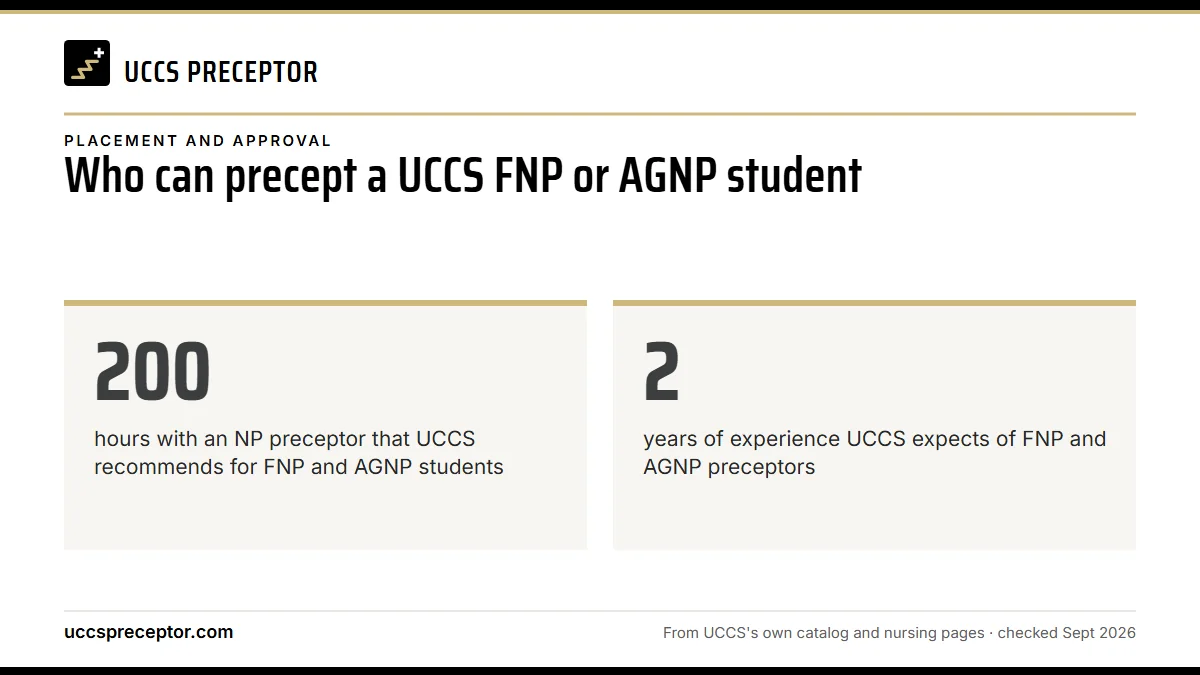
UCCS lets Family and Adult-Gerontology Primary Care NP students train under four kinds of clinician: nurse practitioners, MDs, DOs and physician assistants. Each needs a license in the state hosting your rotation and two years in practice. NP preceptors also need national certification and full prescriptive authority, and UCCS advises logging no fewer than 200 program hours alongside an NP.
Get your placement plan
Tell us your UCCS program and where you live. A placement advisor replies with the preceptor and site options that fit your UCCS course.
UCCS's rule, word for word
The FNP/AGNP Practicum Handbook (08/2026) names eligible preceptors as "NPs, MDs, DOs, or PAs who are licensed in the state where the student is completing clinical hours." For nurse practitioners it adds a second test: "All NPs must be nationally certified with full prescriptive authority." Two years of experience is the baseline for everyone, and the handbook advises that a minimum of 200 program hours be spent with an NP.
| Clinician | Eligible? | Conditions from UCCS's handbook |
|---|---|---|
| Nurse practitioner | Yes | Licensed in the state of your hours; two years of experience; national certification; full prescriptive authority |
| Physician (MD or DO) | Yes | Licensed in the state of your hours; two years of experience |
| Physician assistant | Yes | Licensed in the state of your hours; two years of experience |
| Military provider | Yes, when the other rules are met | Must hold a state license |
| Relative or close friend | No | Excluded by UCCS whatever their credentials |
A single handbook governs both primary care tracks, so the rules apply to FNP and AGNP students equally, whether enrolled in the certificate, the DNP pathway from the BSN, the RN to MSN or the MSN itself.
A license in the state that hosts your rotation
The license test follows the rotation rather than the clinician's home base. Whoever supervises you must hold a license valid in the state hosting your hours, which for most UCCS students means the state they lived in at admission. With approval to train in a second listed state, the preceptor there needs that state's license.
Your own RN license has to fit as well, either as a multistate compact license or as a license issued by the non-compact state where you train. The RN license guide and the approved states page cover both sides.
A few states on UCCS's list, among them California, Arizona and Utah, also set expectations of their own for out-of-state programs and the preceptors those programs use. Check your state's guide on this site before you settle on a preceptor there.
National certification and prescriptive authority
For NP preceptors, a license alone is not enough. The handbook requires national certification and full prescriptive authority, and both are worth confirming before you ask the NP to take you on. An NP who lacks either one falls outside the rule, however experienced. Ask about both in your first conversation; it takes a minute, and a clear answer then spares you a returned site sheet later.
Physicians and PAs are not held to the NP certification line, but they share the two-year experience requirement and the licensing rule. Military clinicians can precept as long as they hold a state license.
The Preceptor Handbook adds a request for each preceptor's resume where one exists, tying that request to CCNE requirements. Having it on hand saves a follow-up email once the preceptor letter is in motion.
Why 200 hours with an NP shapes your plan
The 200-hour figure is a recommendation rather than a pass-or-fail rule, but it steers how you build the program. Physicians and PAs make valuable preceptors, and the recommendation simply points toward a solid share of your hours with clinicians in the role you are training for.
A second rule adds to the planning. No more than 330 of an FNP or AGNP student's hours may come from one preceptor or site, a ceiling lifted only when the site is part of a major health system. The arithmetic follows: 630 hours need at least two preceptors or sites, and 770 hours need at least three, if none of them sits inside a major health system. Map out where your NP hours will come from before you commit to a long rotation with a physician.
The setting rules travel with every preceptor too: primary care only, no hospital rounding and no emergency department, plus limits on urgent care, telehealth and specialty clinics. What counts for FNP and AGNP has the caps.
Who is ruled out, and how PMHNP differs
Relatives by blood or marriage and close friends cannot precept you, and UCCS bars hours at a clinic that employs you or anyone in your family. Your own employer becomes possible only at another location or unit, and only once the Graduate Clinical Practicum Coordinator agrees. The detail is in workplace and family rules. These exclusions hold for the whole program, so a relative who is an excellent clinician stays off your list from NURS 6730 through Synthesis.
Psychiatric-Mental Health NP students follow a different list: psychiatric prescribers, a limited number of hours with certain licensed therapists when approved, and a 200-hour recommendation tied to PMHNPs. See PMHNP preceptor rules. If you are unsure whether a clinician fits either list, ask before you send the site sheet rather than after.
What UCCS asks of preceptors, and what it offers them
UCCS keeps the preceptor's role clear. Once a preceptor passes 24 clinical hours with you, UCCS asks for a Medatrax evaluation, scored from 1 to 4, that feeds into your grade, and the preceptor takes part in one site visit, by phone or in person, after the halfway mark. Site visits and evaluations explains the forms.
In return, UCCS's Preceptor Information page offers documentation of the hours each preceptor supervised during the semester, which may help with recertification depending on the certifying body, use of the UCCS library once a request form is filed, and contact with faculty plus a chance to recruit new graduates. The Preceptor Handbook adds a rotation-level letter delivered via Medatrax, along with pointers to NONPF's Preceptor Portal and AANP's preceptor knowledge center.
UCCS describes precepting as volunteering and lists no payment. Its page links to Colorado's preceptor tax credit for rural and frontier areas, a state program with its own eligibility rules, which Colorado NP practice and preceptors describes.
How we match preceptors to UCCS's rules
Every preceptor we bring you is screened against this page before you hear the name. We confirm the credential, the state license where your hours will happen, two years in practice and, for NPs, national certification and full prescriptive authority. We also check the setting against your course, so the clinician who says yes is one UCCS can approve.
We plan the mix across your program as well, steering your NP time toward UCCS's 200-hour recommendation and spreading rotations so no one preceptor passes the 330-hour ceiling. Approval of each preceptor belongs to UCCS; what we deliver is a match that already meets the college's rules when it lands on the coordinator's desk.
Clinicians interested in teaching UCCS students can read precepting a UCCS student. Students can start with the form below.
Questions UCCS students ask
Is a PA allowed to precept a UCCS FNP student?
Yes. Physician assistants qualify as FNP and AGNP preceptors at UCCS if they hold a license in the state of your rotation and have practiced for two years. Since UCCS also advises spending 200 or more hours with an NP, balance PA and physician rotations with enough NP time across the program.
Does my NP preceptor need to be board certified?
Yes. UCCS's FNP/AGNP handbook requires every NP preceptor to hold national certification and full prescriptive authority. An NP who is licensed but uncertified, or who lacks full prescribing authority in that state, falls outside the rule, whatever their years in practice.
Is 200 hours with an NP required at UCCS?
It is advised rather than required. The handbook suggests that FNP and AGNP students spend a minimum of 200 hours with NP preceptors. Treat it as a planning target, since it is far easier to reach when you decide early which of your rotations will be with NPs.
Can a preceptor licensed in another state supervise me by telehealth?
UCCS links preceptor licensing to the state where you complete the hours, and telehealth is capped at 45 hours over the entire FNP or AGNP program. Any arrangement that crosses a state line needs the Graduate Clinical Practicum Coordinator's approval, so raise it before you send a site sheet.
Do UCCS preceptors get paid?
UCCS lists no payment or honorarium, and its Preceptor Information page calls precepting volunteering. Preceptors receive documentation of their hours, library access, faculty networking and a letter for each rotation level, while Colorado separately runs a state tax credit for eligible rural and frontier preceptors.
Related pages
Last checked 2026-09-25
We check these pages against UCCS's catalog, practicum handbooks and college pages. Your degree plan, the handbook for your cohort and the Graduate Clinical Practicum Coordinator have the final word.
UCCS asks you to find your clinical hours where you live. Let us run that search.
Tell us your UCCS track, your next clinical course and where you live. We find preceptors who fit the course and prepare the details your Clinical Site Sheet needs, early enough for the agreement to be signed before the semester.
- Preceptors matched to the course: pediatrics for
NURS 6900, acute and chronic care forNURS 6915andNURS 6925, psychiatric prescribers forNURS 6801toNURS 6803 - Credentials, license, certification and the site's signer ready for the Clinical Site Sheet
- In Colorado Springs, along the Front Range, or in any of UCCS's approved states
Start your placement plan
Your program, city and next clinical semester is all we need to begin.