UCCS MSN Adult-Gerontology Primary Care NP: courses, hours and the geriatric rotation
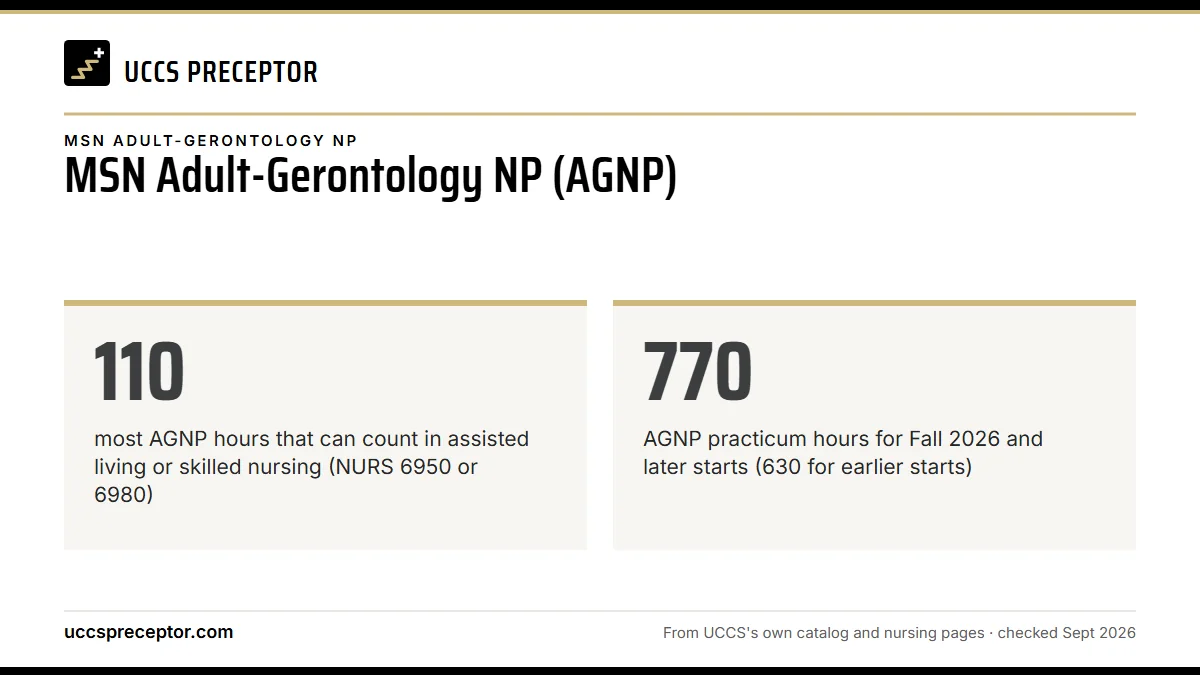
The AGNP is UCCS's primary care track for adults and older adults, taught online with clinical hours completed near home. It shares most of its courses with the Family NP but swaps pediatrics for NURS 6950, a geriatric rotation where assisted living and skilled nursing time can count. Depending on your start term, the track totals 630 or 770 practicum hours, with 45 more in NURS 6730.
Find your AGNP preceptor
Tell us your start term and the rotation you need next.
One track under three names
UCCS labels this option three ways. The 2026-27 catalog calls it the Adult/Geriatric Nurse Practitioner track, the college website says Primary Care Adult-Gerontology (Adult/Gero) Nurse Practitioner, and the practicum handbook uses Adult/Gerontology. They describe one program, which UCCS shortens to AGNP.
The phrase that matters is primary care. UCCS runs no acute care AGNP, and the MSN page steers anyone aiming at emergency or inpatient practice toward an acute care NP program instead. If hospital practice is the goal, weigh that before applying; if outpatient care of adults and older adults is the goal, this is the track designed for it.
The option is delivered online with no campus visits required, totals 47 credits on the college's RN to MSN page, and admits residents of 14 approved states only. Full-time students typically need about three years and part-time students about four, per the catalog, with six years as the limit. The approved states guide names the 14.
AGNP courses and practicum hours
The AGNP runs on the same hour scale as its sister primary care track. Students who started before Fall 2026 earn 45 practicum hours per credit, and those starting Fall 2026 or later earn 55. The one course swap is NURS 6950 where the FNP takes pediatrics. The 630 vs 770 guide helps you pick your column.
| Course | Credits | Started before Fall 2026 | Started Fall 2026 or later |
|---|---|---|---|
NURS 6730 Advanced Health Assessment | 3 | 45 (outside the total) | 45 (outside the total) |
NURS 6915 Primary Care of Acute Care Conditions | 5 | 90 | 110 |
NURS 6925 Primary Care of Chronic Care Conditions | 5 | 90 | 110 |
NURS 6950 Primary Care of Geriatric Patients and Families | 5 | 90 | 110 |
NURS 6960 Gender Health Primary Care | 2 | No hours listed | No hours listed |
NURS 6982 Pre-Synthesis Practicum (not required of all students) | 1-2 | 45-90 | 55-110 |
NURS 6980 Synthesis Practicum | 1-8 | 360 | 440 |
| Track total | 25-26 | 630, plus 45 in NURS 6730 | 770, plus 45 in NURS 6730 |
The catalog leaves the order of the three primary care rotations open. None can begin until your core coursework, including health assessment, pathophysiology and pharmacotherapeutics, is complete. Synthesis then needs the geriatric, acute and chronic courses, gender health and, when your plan lists it, Pre-Synthesis. The acute and chronic guide covers the two rotations both tracks share, and your degree plan sets the semesters.
The geriatric rotation, NURS 6950
The geriatric primary care course, NURS 6950, is what gives the AGNP its identity. Students who began before Fall 2026 log 90 hours in it; later starts log 110. Like the other population courses, it opens only after the full core.
It is also one of two courses where skilled nursing and assisted living time can count, up to a combined ceiling of 110 hours across NURS 6950 and Synthesis. That is a wider long-term care allowance than the Family NP gets, and it lets you work with providers who follow older patients where they live. The work still has to be primary care under an approved preceptor; hospital inpatient time stays off the table.
Because the course centers on older adults, the preceptor you need is one whose panel is weighted toward them. The NURS 6950 guide covers the course and the geriatric preceptor search in depth.
Where AGNP hours can happen
Outside the geriatric course, AGNP rotations follow the same primary care frame as the Family NP, with a few adult-specific allowances written into the 08/2026 handbook.
- Primary care only: no inpatient units, hospital rounding, emergency departments or ED fast-track.
- Women's health: somewhere between 30 and 45 hours, logged within your rotations.
- Urgent care: permitted from rotation two onward, 110 hours at most before Synthesis and 110 within it.
- Specialty clinics: up to 110 hours, in Synthesis only. Adult pulmonology is allowed for AGNP students alongside dermatology, orthopedics, cardiology and the other listed specialties.
- Outpatient hospice: the handbook lists 55 hours for AGNP students.
- Telehealth: 45 hours at most over the whole program.
- Single preceptor or single site: capped at 330 hours, with an exception for major health systems.
Encounter minimums apply as well: 75, 90 and 125 logged patients in the first three clinical courses, then about two an hour in Synthesis. The FNP and AGNP what-counts guide has the full list, including banked hours and campus simulation.
Who precepts AGNP students
Eligible preceptors are NPs, physicians with an MD or DO, and physician assistants who have two years of experience and a license in your rotation state. An NP preceptor also needs national board certification and full prescriptive authority. UCCS suggests logging 200 hours or more with NPs over the course of the program.
Practices that fit the AGNP scope include internal medicine and adult primary care clinics, geriatric practices, and providers who care for patients in assisted living or skilled nursing. Physician and PA preceptors qualify as well, so a strong adult practice without an NP on staff can still carry part of your hours.
Family members and close friends cannot precept you, and a workplace where you or a relative are on staff is off limits, though another branch or unit of your employer may be approved by the Graduate Clinical Practicum Coordinator. The preceptor requirements page holds the full rules.
Why AGNP students choose us
We are built around UCCS's clinical process, and the AGNP search has a shape of its own: adult and geriatric preceptors, a rotation that can include assisted living or skilled nursing, and specialty time held for Synthesis. Our search covers in-person preceptors in your area, each matched to the specific course it will serve.
Each AGNP match includes the facts the college's forms ask for: the provider's credentials, license and board certification, the practice's details, the administrator who can sign an Affiliation Agreement for the site, and a set hour figure. Because your Clinical Site Sheet goes in whole and early, the agreement and preceptor letter can get underway sooner. The approval decision belongs to UCCS, and we prepare every file to meet its standards at the first review.
Our planning runs across the full AGNP sequence: no single preceptor crosses 330 hours, your women's health time has a home, and long-term care hours land where they help most. When a preceptor withdraws, your placement advisor begins a fresh search promptly. Send your start term and the next course through the form below.
Questions UCCS students ask
Is the UCCS AGNP a primary care or an acute care program?
Primary care. The catalog lists only three NP tracks at UCCS, and none of them is acute care. The MSN page describes the program as unsuited to preparing for emergency room or inpatient roles and points those goals toward acute care NP training. AGNP clinical hours are outpatient primary care, with assisted living and skilled nursing allowed in limited amounts.
Can UCCS AGNP students do clinical hours in a nursing home?
Yes, up to a cap. The handbook lets AGNP students log as many as 110 hours in skilled nursing or assisted living settings, in NURS 6950 or during Synthesis. The preceptor still has to meet UCCS's credential rules, and the site needs a processed Clinical Site Sheet plus a signed agreement and preceptor letter before any of those hours begin.
Do UCCS AGNP students need women's health hours?
Yes. The practicum handbook sets a women's health range of 30 to 45 hours, logged inside the clinical rotations. NURS 6960, Gender Health Primary Care, carries credits but no hours of its own, so the women's health time has to be planned into another course with a preceptor or site that sees those patients.
What is the difference between the UCCS AGNP and FNP?
The two tracks share the core, the acute and chronic rotations, Pre-Synthesis and Synthesis. The FNP takes NURS 6900 in pediatrics, while the AGNP takes NURS 6950 in geriatrics. Hour totals and preceptor rules are identical. The real difference is the patient population and the preceptors you look for; the FNP guide covers the other track.
How many credits is the UCCS AGNP?
The college's RN to MSN page lists 47 credits for the Adult/Gero option, and the catalog gives 47-48 for the MSN overall. That divides into a shared core of 22-23 credits and an NP track of 25-26. RN to MSN students complete the 6-credit NURS 4460 bridge before any MSN course begins.
Related pages
Last checked 2026-09-25
We check these pages against UCCS's catalog, practicum handbooks and college pages. Your degree plan, the handbook for your cohort and the Graduate Clinical Practicum Coordinator have the final word.
UCCS asks you to find your clinical hours where you live. Let us run that search.
Tell us your UCCS track, your next clinical course and where you live. We find preceptors who fit the course and prepare the details your Clinical Site Sheet needs, early enough for the agreement to be signed before the semester.
- Preceptors matched to the course: pediatrics for
NURS 6900, acute and chronic care forNURS 6915andNURS 6925, psychiatric prescribers forNURS 6801toNURS 6803 - Credentials, license, certification and the site's signer ready for the Clinical Site Sheet
- In Colorado Springs, along the Front Range, or in any of UCCS's approved states
Start your placement plan
Your program, city and next clinical semester is all we need to begin.