UCCS nursing grades, dismissal rules and time limits
Every nursing course in a UCCS graduate program has the same passing line, a B (84%), and falling under it a second time ends the program. A clinical failure sinks the entire course, and retaking that course means doing its clinical hours over. Time limits, leaves of absence and your individual degree plan set the pace around those rules.
Keep your rotations on track
A preceptor who fits your course protects your grade. Tell us your next rotation and start term.
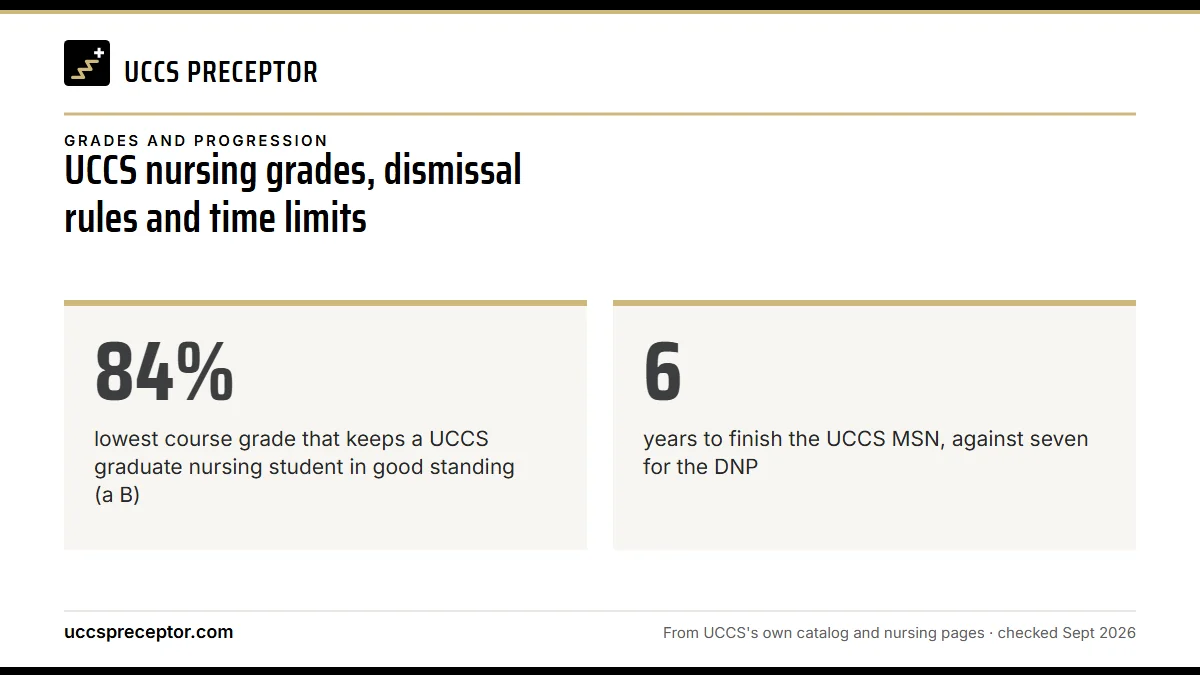
The grade floor is a B, which UCCS sets at 84%
UCCS's documents state the floor in slightly different words, but they land in the same place. Read side by side, they make 84% the lowest grade that keeps you safe, and a B- (80 to 83 on the nursing scale) falls below the line in every version.
| Source | How it states the minimum |
|---|---|
| 2026-27 catalog, Nursing MSN | "A grade of 'B' or higher in all core and NP option courses", with a 3.0 GPA |
| Graduate Nursing Student Handbook (April 2024) | Course grades above a B (84%); its scale sets B at 84-86 and B- at 80-83 |
| 08/2026 practicum handbooks | Dismissal after a grade of B- or less in two classes |
| UCCS Graduate School (catalog) | B- for doctoral courses and C for master's courses; the nursing policy is stricter |
The last row trips people up. A C that the Graduate School would accept in another master's program does not keep you in good standing in nursing, because the college's grading policy differs from, and is stricter than, the Graduate School's.
The handbook's "above a B (84%)" phrasing sits awkwardly next to a scale where a B starts at 84, so read it as 84% or better and ask lead faculty if a borderline grade ever depends on the difference.
Two grades below B end the program
One grade below B is survivable. You may repeat that course once, with permission from the instructor and the Department Chair. A second course grade below B, meaning under 84%, brings dismissal from the graduate nursing program, and so does a cumulative GPA below 3.0.
The practicum handbooks phrase the same rule from the other direction: two grades of B- or lower during your graduate work and you are dismissed. The count runs across the whole program rather than per semester, so an early low grade in a didactic course leaves no margin for a clinical course later.
The DNP project series has its own terms. Each course from NURS 8050 through NURS 8054 needs a B or better, a project course you fail comes around again only the following year, and a second failing grade at any point in the DNP ends your enrollment.
Clinical failure fails the whole course
UCCS grades each clinical course as a single unit. Fail the clinical portion and you fail the course, and in the handbook's words, "Repeating the course also includes repeating the clinical hours." If that failure is your second grade below B, dismissal follows.
It works the other way too. Pass clinical but fail the didactic portion and you still repeat the clinical hours along with the course. Your preceptor's Medatrax evaluation and the site visitor's evaluation both count toward the grade, so a rotation with a poorly matched preceptor puts more at risk than a few lost weeks.
A repeated clinical course comes with its full clinical hours again, so a new placement has to be ready for the repeat semester.
Time limits and leaves of absence
Every UCCS graduate nursing program has an outer limit, and the catalog and program pages also describe a typical pace.
| Program | Time limit | Typical pace UCCS describes |
|---|---|---|
| MSN (FNP, AGNP, PMHNP) | Six years | 3 years full-time or 4 years part-time |
| RN to MSN | Six years | 3 to 5 years |
| BSN to DNP and Post-Master's DNP | Seven years | Not stated |
A leave of absence can be renewed one semester at a time, up to three semesters. Stay away more than one calendar year and you must reapply. Returning also brings a skills check: FNP and AGNP students complete a Head-to-Toe Assessment remediation after a leave longer than two semesters, and the PMHNP handbook sets that trigger at three semesters away.
Your degree plan decides the sequence
Each admitted student receives an individual degree plan, and UCCS publishes no standard semester-by-semester sequence to compare it with. That makes your plan the working document for course order, and the easiest place to confirm the start term that places you on 630 or 770 hours.
You can ask for a revised plan, but the graduate handbooks allow no more than three degree plans without a written reason. Every change ripples into placement: moving a primary care rotation to a later term moves the semester your preceptor must be ready and the date your Clinical Site Sheet needs to reach UCCS.
The catalog sets a few fixed gates. Every primary care course requires all 6000-level MSN core courses plus the advanced practice core, NURS 6730, NURS 6740 and NURS 6280. Synthesis in NURS 6980 waits until the acute, chronic and gender health courses are done along with your population rotation (NURS 6900 for FNP, NURS 6950 for AGNP), plus NURS 6982 when your plan includes it. The PMHNP synthesis, NURS 6985, follows NURS 6802, NURS 6801 and NURS 6800. An open incomplete can also hold you out of Synthesis; see semester rules and incompletes.
Protecting your grade with a placement that holds
Why UCCS students choose us: a well-matched preceptor protects the parts of your grade that study alone cannot fix, the preceptor evaluation, the site visit and the encounter counts in your logs. We match you to a preceptor whose setting fits your course, confirm the hours they can give, and have the Clinical Site Sheet details ready early.
A preceptor who leaves mid-course sets us searching at once, so an incomplete stays the fallback rather than the plan. Every approval rests with the college; our work is making sure the paperwork it sees is whole and correct on arrival. See how it works, or read delayed graduation if a placement gap already threatens your timeline.
Questions UCCS students ask
Is a B- a passing grade in UCCS graduate nursing?
Not for progression. A B- covers 80 to 83 on the graduate nursing scale, below the 84% floor, and it counts toward the two-grade dismissal rule in the practicum handbooks. You may repeat one such course with instructor and Department Chair permission, but a second grade at that level ends the program.
If I fail the exams but pass clinical, do I repeat my hours?
Yes. The FNP/AGNP handbook says a student who passes the clinical portion but fails the didactic portion repeats the clinical hours with the course. That means another semester with a preceptor, a new Clinical Site Sheet and a fresh set of Medatrax logs, so begin arranging the repeat placement as soon as the grade is final.
What grade do I need in the RN to MSN bridge course?
An 84% (B) in NURS 4460 is required to move into the MSN. If you fall short, UCCS lets you repeat the bridge once or switch to the RN to BSN, where its 6 credits count as electives. The bridge is fully asynchronous and has no clinical component, so no preceptor is involved at that stage.
What grade do RN to BSN students need in NURS 4450?
The undergraduate standard governs NURS 4450: 74%, a C, in each required nursing course. After an ordinary first failure you work out a plan with your advisor. Dismissal comes with a second failure, or at once when a failure involves safety or professional conduct, and the Admissions and Progressions Committee hears a single appeal.
Can my preceptor's evaluation affect my course grade?
Yes. Any preceptor whose time with you passes 24 clinical hours fills in a Medatrax evaluation, and it feeds your grade together with the site visitor's report. Talk with your preceptor early about expectations, and tell lead faculty promptly if a rotation is going badly rather than waiting for the final form.
Related pages
Last checked 2026-09-25
We check these pages against UCCS's catalog, practicum handbooks and college pages. Your degree plan, the handbook for your cohort and the Graduate Clinical Practicum Coordinator have the final word.
UCCS asks you to find your clinical hours where you live. Let us run that search.
Tell us your UCCS track, your next clinical course and where you live. We find preceptors who fit the course and prepare the details your Clinical Site Sheet needs, early enough for the agreement to be signed before the semester.
- Preceptors matched to the course: pediatrics for
NURS 6900, acute and chronic care forNURS 6915andNURS 6925, psychiatric prescribers forNURS 6801toNURS 6803 - Credentials, license, certification and the site's signer ready for the Clinical Site Sheet
- In Colorado Springs, along the Front Range, or in any of UCCS's approved states
Start your placement plan
Your program, city and next clinical semester is all we need to begin.