The UCCS MSN Family Nurse Practitioner track, rotation by rotation
UCCS's Family NP option is an online MSN built on primary care rotations across the lifespan, from pediatrics to a long Synthesis practicum. You owe 630 or 770 practicum hours depending on your start term, plus 45 in NURS 6730, and every preceptor is one you line up in your own approved state. This guide sets out the courses, their order and what each rotation asks of your search.
Find your FNP preceptor
Tell us your start term and your next clinical course.
What the FNP option looks like at UCCS
The Family NP option is one of three nurse practitioner tracks inside the Nursing MSN at the Helen and Arthur E. Johnson Beth-El College of Nursing and Health Sciences. Coursework is online, and the MSN page states "No Campus Visits Required." The catalog lists 47-48 credits for the degree: a 22-23 credit core that every track shares and a 25-26 credit NP track.
Plan on roughly three years of full-time study or four part time, by the catalog's estimate, with six years as the hard ceiling; spring, summer and fall are all start options. The track trains you for primary care of patients at every age. UCCS says plainly that it is not preparation for emergency room or inpatient work, which it describes as better suited to an acute care NP program.
UCCS admits only residents of 14 states, since both the classes and every practicum hour must take place in one of them. The college treats the state you lived in when you applied as your residence, so the preceptors you need are the ones near home. The approved states guide lists all 14.
FNP courses and practicum hours
Hours are fixed per course, and the figure you owe turns on when you started. For Fall 2026 starts and later, UCCS counts 55 clinical hours per credit instead of 45, which lifts the track from 630 to 770 practicum hours. The 630 vs 770 guide explains the change and the older documents that still print 630.
| Course | Credits | Started before Fall 2026 | Started Fall 2026 or later |
|---|---|---|---|
NURS 6730 Advanced Health Assessment | 3 | 45 (outside the total) | 45 (outside the total) |
NURS 6900 Primary Care of Pediatric Patients and Families | 5 | 90 | 110 |
NURS 6915 Primary Care of Acute Care Conditions | 5 | 90 | 110 |
NURS 6925 Primary Care of Chronic Care Conditions | 5 | 90 | 110 |
NURS 6960 Gender Health Primary Care | 2 | No hours listed | No hours listed |
NURS 6982 Pre-Synthesis Practicum (not required of all students) | 1-2 | 45-90 | 55-110 |
NURS 6980 Synthesis Practicum | 1-8 | 360 | 440 |
| Track total | 25-26 | 630, plus 45 in NURS 6730 | 770, plus 45 in NURS 6730 |
Two rows cause most of the questions. NURS 6960 carries credits but no listed hours, since women's health time is logged inside other rotations. And the handbook is silent on how NURS 6982 hours fit into the overall count, so your degree plan is where you see whether Pre-Synthesis applies to you at all.
The order you take them in
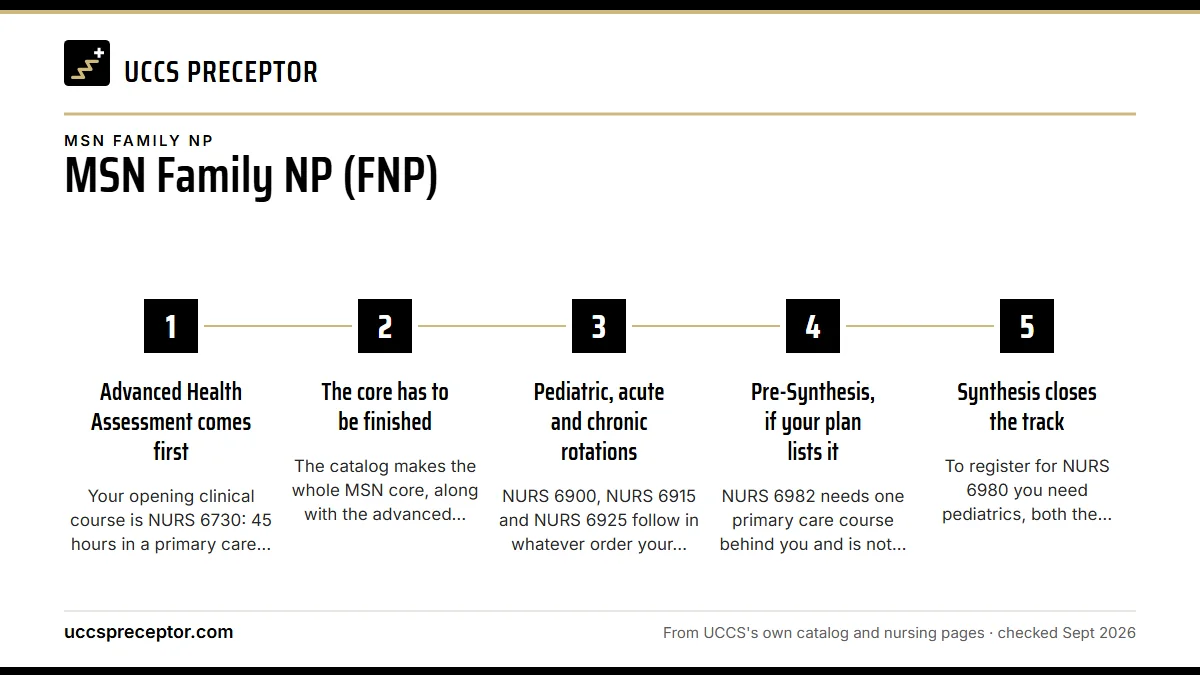
UCCS publishes no semester-by-semester FNP map. Each admitted student gets an individual degree plan, and the catalog prerequisites pin down only a few fixed points. It helps to read the sequence as a chain of preceptor searches, since every clinical course needs its own approved site and paperwork.
- Advanced Health Assessment comes firstYour opening clinical course is
NURS 6730: 45 hours in a primary care setting, where emergency departments, urgent care, skilled nursing and specialty clinics are excluded. The NURS 6730 guide walks through that first search. - The core has to be finishedThe catalog makes the whole MSN core, along with the advanced practice trio of
NURS 6280,NURS 6730andNURS 6740, a prerequisite for each primary care course. Population rotations wait until the core is behind you. - Pediatric, acute and chronic rotations
NURS 6900,NURS 6915andNURS 6925follow in whatever order your degree plan sets; the catalog does not lock one in. See the pediatric course guide and the acute and chronic guide. - Pre-Synthesis, if your plan lists it
NURS 6982needs one primary care course behind you and is not required of every student. - Synthesis closes the trackTo register for
NURS 6980you need pediatrics, both the acute and the chronic course, gender health and, if your plan includes it, Pre-Synthesis. It is the largest block of hours in the program, covered in the Synthesis guide.
Setting rules that shape an FNP search
The FNP is a lifespan track, so across your rotations the preceptor mix has to reach children, adults and women's health. Everything stays in primary care: UCCS counts no inpatient time, no hospital rounding and no emergency department or ED fast-track work toward FNP hours.
FNP rules from the 08/2026 practicum handbook
- Pediatrics:
NURS 6900focuses on children and families in primary care, and women's health hours cannot be logged there. - Women's health: a 30-hour floor and a 45-hour ceiling, logged in any rotation other than pediatrics.
- Urgent care: allowed once you reach your second rotation, capped at 110 hours there and another 110 during Synthesis.
- Specialty clinics such as dermatology, orthopedics or cardiology: up to 110 hours, in Synthesis only.
- Long-term care and hospice or palliative care: 55 hours of each encouraged during Synthesis.
- Telehealth: a 45-hour cap for the entire program.
- One preceptor or one site: 330 hours at most, unless it is a major health system.
Patient volume counts as much as the clock. The handbook expects at least 75, 90 and 125 logged encounters in the first three clinical courses and about two patients an hour in Synthesis, so a slow clinic can leave you short even with full hours. The complete rules are in the FNP and AGNP what-counts guide.
Who can precept a UCCS FNP student
Your FNP preceptors can be nurse practitioners, physicians (MD or DO) or physician assistants, each holding a license in the state of the rotation and at least two years in practice. NP preceptors need national certification and full prescriptive authority. The handbook recommends at least 200 of your hours with an NP, which is worth building in early if the practices near you are mostly physician-led.
Relatives by blood or marriage and close friends are ruled out, as is a clinic that employs you or someone in your family. An employer can still host you at a separate location or on another unit if the Graduate Clinical Practicum Coordinator signs off. The preceptor requirements page covers every detail.
After a preceptor agrees, you record the placement on a Clinical Site Sheet; the college turns it into an Affiliation Agreement and a preceptor letter, then sends a "good to go" email before hours may start. Legal review of a first-time agreement runs 6 to 8 weeks and sometimes more, so the handbook advises beginning your search three to six months before the course.
Why UCCS FNP students choose us
We specialize in UCCS's clinical process, and the FNP track is where that focus pays off most: as many as six clinical courses, each with its own setting rules. We hunt for pediatric, acute, chronic and Synthesis preceptors close to home, for in-person rotations, and screen every candidate against UCCS's credential list before a name goes to the college.
Each FNP match comes with a ready file for your Clinical Site Sheet: who the preceptor is and what they hold (degree, state license, board certification), the clinic's address and contacts, the official who signs contracts for the site, and a fixed hour count for the term. With that in hand, your sheet reaches the Academic Services Professional for Graduate Nursing well ahead of the semester. The college decides on every placement, and our job is to hand it a file built to clear review on the first pass.
We also map the whole FNP sequence: keeping each preceptor under 330 hours, deciding which rotation carries your women's health time, and judging whether urgent care belongs in your second course. Should a preceptor pull out mid-plan, your placement advisor begins lining up a replacement without waiting for the next term. Use the form below to send your start term and the course you need next.
Questions UCCS students ask
Does UCCS find FNP preceptors for its students?
No UCCS source promises a placement. The MSN page says primary care hours are found by students in the places they live, and the practicum handbook adds that UCCS cannot share lists of sites that already hold agreements. The Graduate Clinical Practicum Coordinator reviews site suitability and can be contacted for help; the search itself falls to you, and that search is what we take on.
Is the UCCS FNP program fully online?
The coursework is. The 2026-27 catalog says all graduate courses are offered online, and the MSN page lists no campus visits. Clinical hours happen in person with preceptors near home. The one campus-linked option is as many as 20 hours from simulation or skills lab sessions that can count toward Synthesis, and students who cannot travel can ask the Option Coordinator about alternatives.
Can UCCS FNP hours be done in urgent care or an ER?
Urgent care is allowed within limits: up to 110 hours from your second rotation on, and up to 110 more in Synthesis. Emergency departments, ED fast-track, hospital inpatient units and hospital rounding do not count for FNP students, and NURS 6730 excludes urgent care entirely. Every rotation is framed around primary care.
How long does the UCCS FNP take?
Most MSN students need three years full time or four years part time, according to the catalog, and six years is the outer limit. The clinical courses require the core first, so the rotations fill the later part of your plan. Your personal degree plan, issued when you are admitted, fixes the real sequence, and UCCS limits how many times it can be redone without a written reason.
Can I do FNP clinical hours outside my home state?
You need the Graduate Clinical Practicum Coordinator to approve it, and the state must be on UCCS's approved list. A compact state requires a multistate RN license; a non-compact state requires an active RN license issued there. The preceptor, too, must hold a license in that state, so the search follows the license map.
Do I need a pediatric preceptor for the UCCS FNP?
Yes. NURS 6900, the pediatric primary care course, carries 90 or 110 hours depending on your start term, so you need a primary care preceptor whose patients include children. Women's health hours cannot count in that course. AGNP students take a geriatric course in its place, which is the main clinical difference between the two primary care tracks.
Related pages
Last checked 2026-09-25
We check these pages against UCCS's catalog, practicum handbooks and college pages. Your degree plan, the handbook for your cohort and the Graduate Clinical Practicum Coordinator have the final word.
UCCS asks you to find your clinical hours where you live. Let us run that search.
Tell us your UCCS track, your next clinical course and where you live. We find preceptors who fit the course and prepare the details your Clinical Site Sheet needs, early enough for the agreement to be signed before the semester.
- Preceptors matched to the course: pediatrics for
NURS 6900, acute and chronic care forNURS 6915andNURS 6925, psychiatric prescribers forNURS 6801toNURS 6803 - Credentials, license, certification and the site's signer ready for the Clinical Site Sheet
- In Colorado Springs, along the Front Range, or in any of UCCS's approved states
Start your placement plan
Your program, city and next clinical semester is all we need to begin.