NURS 6915 and 6925: the acute and chronic primary care rotations
NURS 6915 Primary Care of Acute Care Conditions and NURS 6925 Primary Care of Chronic Care Conditions are the two rotations the UCCS Family NP and AGNP tracks share. Each carries 90 hours for students who started before Fall 2026 and 110 for Fall 2026 starts and later, and together they are the natural home for your women's health hours and, once you reach your second rotation, urgent care.
Plan both rotations with us
Tell us your track, start term and which of the two courses comes first on your degree plan.
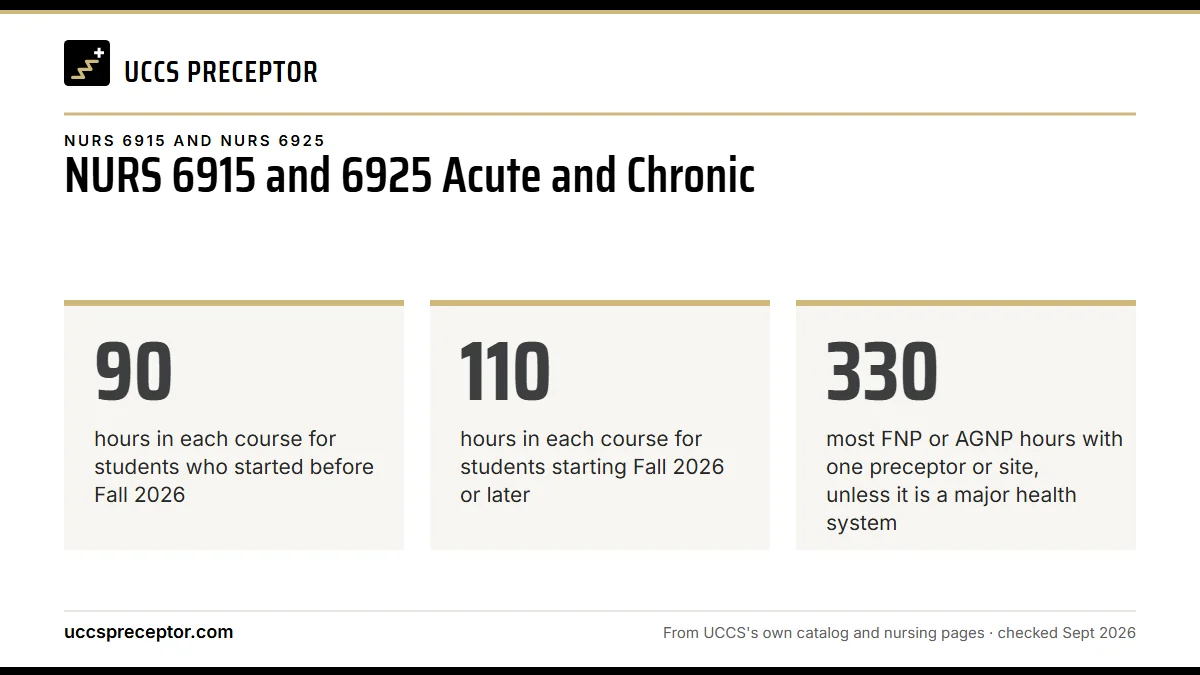
Two rotations shared by both primary care tracks
FNP students take these two courses alongside pediatrics (NURS 6900); AGNP students take them alongside geriatrics (NURS 6950). Each is 5 credits, and each requires the whole 6000-level MSN core and the advanced practice core, NURS 6730 included. RN to MSN, BSN to DNP and certificate students on either primary care track take the same pair. Neither course is tied to a fixed semester; UCCS admits graduate students in spring, summer and fall, and each plan is built from the start term.
The catalog leaves the order of primary care courses open, so your degree plan decides whether acute or chronic comes first and whether either one is your opening rotation. Both must be complete, with no incomplete outstanding, before NURS 6980 Synthesis can begin. The program guides for the MSN FNP and MSN AGNP show where the pair sits in each track.
Hours and patient logs in each course
The hour figure follows your start term. Pre-Fall 2026 students count 45 hours per practicum credit and later starts count 55, which is why the same course carries two numbers.
| Course | Started before Fall 2026 | Started Fall 2026 or later |
|---|---|---|
| NURS 6915 Acute Care Conditions | 90 | 110 |
| NURS 6925 Chronic Care Conditions | 90 | 110 |
| Both courses together | 180 | 220 |
Patient-log floors rise from course to course, 75 patients first, then 90, then 125, each entered in Medatrax with diagnosis, procedure and visit-level codes. Whichever of these two courses falls third for you carries the top floor; your lead faculty can say which number binds in your order.
A few older UCCS documents still print 630 as the program total. The 08/2026 handbook ties the total to your start term, and the 630 vs 770 page sorts out which one is yours.
NURS 6915: what an acute care site looks like
Acute here means acute problems met in primary care, not hospital medicine. A strong NURS 6915 site is an outpatient family or internal medicine practice with a steady flow of same-day visits: new complaints, minor injuries and infections that need a diagnosis and a plan before the patient leaves.
Emergency departments and ED fast-track units never count, and neither does inpatient or hospital work. Urgent care is the variable. The handbook allows up to 110 urgent care hours from your second rotation onward, with a separate 110 held for Synthesis. If NURS 6915 is your second or third rotation, an urgent care preceptor can supply hours up to that cap; if it is your first, urgent care time will not count toward the course.
Urgent care only counts from your second rotation onward, so check where NURS 6915 falls on your degree plan before accepting an urgent care preceptor.
NURS 6925: what a chronic care site looks like
The chronic care course calls for continuity: a practice where patients come back for ongoing management and your preceptor adjusts plans over months. Family medicine, internal medicine and community health clinics fit well, and for AGNP students a practice weighted toward adults and older adults matches the track.
Two limits shape this course more than the acute one. Telehealth counts for no more than 45 hours across the whole program, so video follow-ups with a chronic care preceptor can use up that allowance quickly. Mental health is the second: the handbook recommends about 30 hours, but time in a stand-alone mental health clinic counts only in Synthesis, as specialty hours. The limit names the setting, a mental health clinic, rather than the condition, so ask lead faculty how they want mental health visits in a primary care office logged.
Women's health, and one preceptor for both courses
UCCS requires at least 30 and no more than 45 women's health hours, placed in any rotation except pediatrics. NURS 6960 Gender Health Primary Care carries no hours of its own, so for FNP students this pair, along with Synthesis, is where those hours go; AGNP students can also place them in NURS 6950. A practice with a regular women's health day, or a second preceptor for a few shifts, covers it.
Keeping one preceptor for both courses is allowed and can simplify the paperwork. Together they total 180 or 220 hours, well inside the 330-hour limit on any single preceptor or site. The catch comes later: carrying that same preceptor through all of Synthesis would push past 330 unless the site belongs to a major health system. You also need a fresh Clinical Site Sheet each semester even when nothing else changes; see the site sheet guide.
Planning both searches with us
The best time to plan these rotations is together, before the first one starts. Our placement desk reads your degree plan order, then searches for an acute care site and a chronic care site where you live, or one practice that fits both, and verifies each preceptor's license, board certification and years in practice.
If NURS 6915 falls second or later, we can widen the acute search to urgent care within the handbook's limit, and we flag women's health options so your 30 to 45 hours are covered. For every preceptor we assemble the site sheet details: credentials, license and certification, site information, the person who signs agreements for the site, and an exact hour figure. UCCS approves; we hand the college a complete file early.
UCCS allows three new Affiliation Agreements per semester before Synthesis, so we favor sites that keep that count low, and your placement advisor stays on call if a preceptor steps away. Start with the form below or see how it works.
Questions UCCS students ask
Which comes first, NURS 6915 or NURS 6925?
UCCS does not set the order. The catalog gives both the same prerequisites, the MSN core plus the advanced practice core, and your individual degree plan places them. Order still matters in practice: it decides your patient-log minimum and whether urgent care hours can count, so check your plan before choosing preceptors.
Can an internal medicine physician precept an FNP student in NURS 6925?
Yes. MDs and DOs are accepted preceptors for FNP and AGNP students when they are licensed where you do the hours and have two years of experience. Because UCCS recommends at least 200 program hours with an NP, balance physician-led rotations with NP preceptors elsewhere in your plan.
Do I need a new Clinical Site Sheet if my preceptor stays the same for NURS 6925?
Yes. UCCS asks for a new site sheet every semester, even with the same preceptor at the same site, showing the exact hours for that course. The existing Affiliation Agreement may still cover the site, but a signed preceptor letter is needed for each rotation, and hours wait for the "good to go" email.
What happens if I fail the clinical part of NURS 6915?
Failing the clinical component fails the whole course, and repeating it means repeating the 90 or 110 hours too. You need a B (84%) or better, and a second grade of B- or lower in the program ends in dismissal. The grades and progression page covers the full rules.
Is there a site visit in both courses?
Yes. Each clinical course gets one site visit under the FNP/AGNP handbook, in person or by phone, scheduled after you pass the midpoint of that course's hours. The visit and your preceptor's evaluation both count toward the grade. Details are on the site visits and evaluations page.
Related pages
Last checked 2026-09-25
We check these pages against UCCS's catalog, practicum handbooks and college pages. Your degree plan, the handbook for your cohort and the Graduate Clinical Practicum Coordinator have the final word.
UCCS asks you to find your clinical hours where you live. Let us run that search.
Tell us your UCCS track, your next clinical course and where you live. We find preceptors who fit the course and prepare the details your Clinical Site Sheet needs, early enough for the agreement to be signed before the semester.
- Preceptors matched to the course: pediatrics for
NURS 6900, acute and chronic care forNURS 6915andNURS 6925, psychiatric prescribers forNURS 6801toNURS 6803 - Credentials, license, certification and the site's signer ready for the Clinical Site Sheet
- In Colorado Springs, along the Front Range, or in any of UCCS's approved states
Start your placement plan
Your program, city and next clinical semester is all we need to begin.