UCCS Affiliation Agreements, preceptor letters and the "good to go" email
Before a single UCCS clinical hour counts, two documents must be signed: the Affiliation Agreement, UCCS's legal contract with the health care agency, and the preceptor agreement letter. UCCS drafts both from your Clinical Site Sheet. A new agreement can need six to eight weeks or longer, and outside Synthesis each semester allows only three new ones.
Get your placement plan
Tell us your UCCS program and where you live. A placement advisor replies with the preceptor and site options that fit your UCCS course.
Two documents behind every rotation
UCCS's handbooks put the requirement in one sentence: "A fully executed Affiliation Agreement (legal contract) and a signed preceptor agreement letter for every health care agency are required for each student rotation." The first binds UCCS and the agency. The second involves the individual clinician who will supervise you.
The Graduate Nursing Department drafts both from the Clinical Site Sheet you send. You write neither one, but you shape how quickly they move, because the sheet's details decide who receives the drafts and whether anything is missing when they land. The Clinical Site Sheet guide covers what the sheet needs.
On the agency's side, the contract is signed by whoever holds contracting authority. UCCS's NURS 4450 site sheet, written for RN to BSN students, notes that this person is most likely not the clinician you work with, and the same often holds in NP settings. Learning that name early is one of the simplest ways to save time.
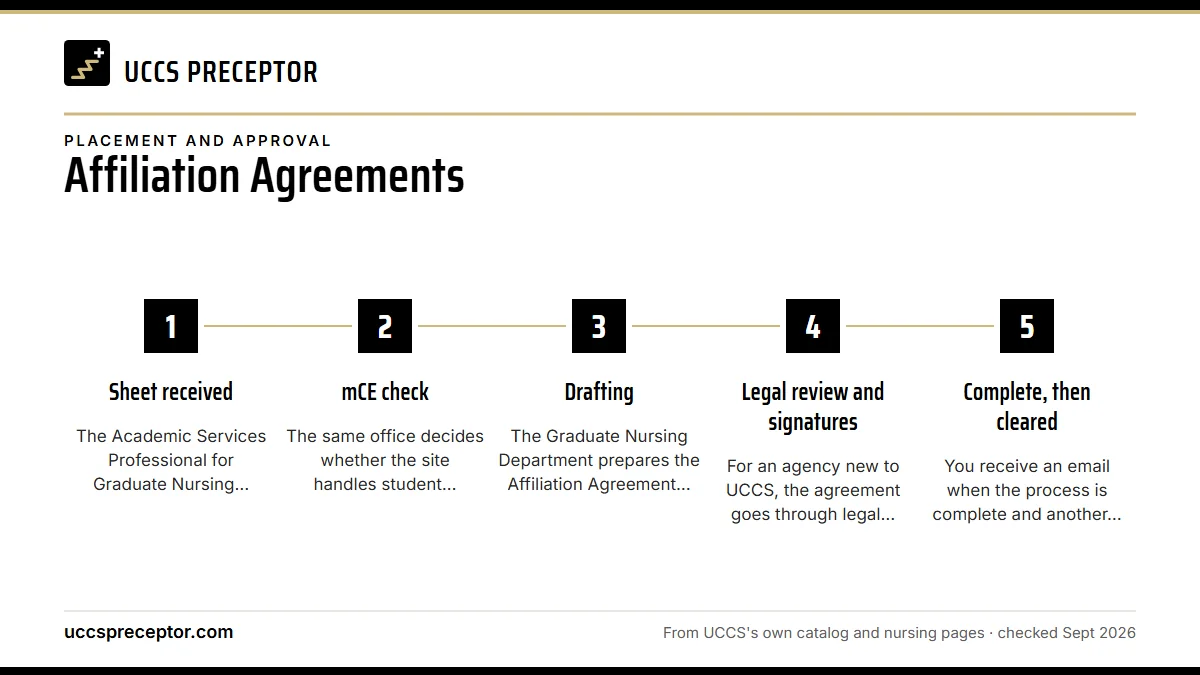
How an agreement moves through UCCS
- Sheet receivedThe Academic Services Professional for Graduate Nursing processes your Clinical Site Sheet and emails you that the agreement process has started.
- mCE checkThe same office decides whether the site handles student rotations through myClinicalExchange. If it does, UCCS submits the rotation request there, and you register for and pay for an mCE account.
- DraftingThe Graduate Nursing Department prepares the Affiliation Agreement for the agency and the preceptor agreement letter for your preceptor.
- Legal review and signaturesFor an agency new to UCCS, the agreement goes through legal review, which can take weeks. The agency and UCCS execute the contract, and your preceptor signs and returns the letter.
- Complete, then clearedYou receive an email when the process is complete and another when you may begin hours. Only after that last message does your first hour count.
Six to eight weeks, sometimes longer
The handbooks give the one published duration in the whole process: "It takes 6 to 8 weeks or longer for the legal review process to establish a new Affiliation Agreement if legal issues are involved. Occasionally, the legal issues cannot be resolved, and the site cannot be used by the student."
Three details in that passage matter. The figure applies to a new agreement, so a site that already holds one with UCCS may not face the same wait. It applies when legal issues are involved, which is hard to predict from outside, since large health systems and small practices both keep contract terms of their own. And the review can fail outright, sending you back to find another site.
That is why the handbooks ask for the site sheet so early. The lead-time guide works the timing into dates for the next two terms.
The three-agreement limit
UCCS caps how many new contracts one student can generate: "No more than three (3) new Affiliation Agreements are allowed to be submitted for clinical rotation sites per semester." The Synthesis courses, NURS 6980 for FNP and AGNP students and NURS 6985 for PMHNP students, are exempt.
The cap shapes strategy. Spreading one primary care rotation across several small practices, each needing a new agreement, can reach the limit fast, while a site already under contract with UCCS is not new. Synthesis is where the exemption earns its place, since its large block of hours often needs more than one site.
If a preceptor drops out and you need a fourth agreement, the handbooks allow a written explanation to the Option Coordinator, the Academic Services Professional and the Graduate Clinical Practicum Coordinator. The steps are in when a preceptor falls through.
The "good to go" email and why it matters
The final email in the sequence is the one that counts. UCCS's handbooks are emphatic: "Student MAY NOT begin clinical hours at a site until the contract with the agency is signed AND the preceptor letter is signed and returned." Hours done earlier "will NOT be counted," and nothing may be done while paperwork is still being processed.
The reasons are practical. UCCS ties its semester and contract rules to professional liability and Workers' Compensation, and students are covered by the university's Workers' Compensation program for injury or exposure during a clinical rotation. Time at a site before the contract is signed sits outside that framework.
Keep the email once it arrives. If a question comes up later about when your hours began, it is your record that the process was complete.
A preceptor saying "come in Monday" is not the start signal. The email from UCCS is.
Sites with extra steps of their own
Some agencies layer their own process on top of UCCS's. The most common is myClinicalExchange, which UCCS uses for graduate rotations only when a site requires it; the mCE guide explains the account and how it fits.
Large systems can also set rules about which schools they accept. UCCS's 08/2026 handbook notes that Denver Health may restrict students, employees included, and take students only from select universities. Sites may ask for immunizations UCCS itself does not require, such as COVID-19, and the handbooks tell students to meet them; see immunizations and compliance.
None of these steps replaces the Affiliation Agreement. They run alongside it, which is one more reason to start early. Ask about them the first time you speak with a site: a clinic that mentions its own student portal or onboarding is telling you to add weeks to your plan.
How we prepare a site for UCCS's agreement
An agreement moves fastest when the site expects it and the paperwork arrives complete. When we place you, we confirm the preceptor's credentials against UCCS's rules, identify the person at the agency who signs clinical education agreements, and note whether the site works through myClinicalExchange, all before your Clinical Site Sheet goes in.
We also brief the preceptor on the letter UCCS will send, so it comes back signed rather than sitting in an inbox. UCCS drafts and approves every agreement; a complete, rule-ready submission from our side gives its legal review the best chance of a quick finish.
If an agreement stalls or a site turns out to be unusable, we are already working on the next option. Tell us about your rotation in the form below, or read how it works.
Questions UCCS students ask
Who signs the Affiliation Agreement at my clinical site?
Someone at the agency with authority to sign contracts, often an administrator or manager rather than your preceptor, and UCCS signs for the university. Your preceptor signs the separate preceptor agreement letter. Find out the agency signer's name before you send your site sheet so the draft reaches the right person the first time.
What is the difference between the Affiliation Agreement and the preceptor letter?
The Affiliation Agreement is the legal contract between UCCS and the health care agency. The preceptor agreement letter is signed by the individual clinician who supervises you. UCCS requires both for each rotation, drafts both from your Clinical Site Sheet, and counts no hours until both are signed.
Can I use a site that already has an agreement with UCCS?
Yes, and it may move faster, since the six-to-eight-week estimate applies to establishing a new agreement. UCCS does not share its list of contracted sites, so you may learn a site has one from the site itself or when UCCS processes your sheet. You still send a new sheet and need a signed preceptor letter.
What happens if UCCS's legal review cannot be resolved?
The handbooks say that, occasionally, the site cannot be used. You then need another site and a new Clinical Site Sheet, and the replacement agreement counts toward that semester's limit of three new ones. If that pushes you past the cap, a written request to the Option Coordinator and the two coordinators is the way to ask for another.
Does the three-agreement limit apply in Synthesis?
No. The handbooks exempt the Synthesis courses, NURS 6980 for FNP and AGNP students and NURS 6985 for PMHNP students. That matters because Synthesis carries the largest block of hours in each track and often needs more than one site to complete.
Related pages
Last checked 2026-09-25
We check these pages against UCCS's catalog, practicum handbooks and college pages. Your degree plan, the handbook for your cohort and the Graduate Clinical Practicum Coordinator have the final word.
UCCS asks you to find your clinical hours where you live. Let us run that search.
Tell us your UCCS track, your next clinical course and where you live. We find preceptors who fit the course and prepare the details your Clinical Site Sheet needs, early enough for the agreement to be signed before the semester.
- Preceptors matched to the course: pediatrics for
NURS 6900, acute and chronic care forNURS 6915andNURS 6925, psychiatric prescribers forNURS 6801toNURS 6803 - Credentials, license, certification and the site's signer ready for the Clinical Site Sheet
- In Colorado Springs, along the Front Range, or in any of UCCS's approved states
Start your placement plan
Your program, city and next clinical semester is all we need to begin.