What counts toward UCCS FNP and AGNP hours
For UCCS FNP and AGNP students, hours count only in primary care: no inpatient units, no hospital rounding and no emergency department. Within that rule, the 08/2026 practicum handbook sets a floor for women's health, ceilings for urgent care, specialty clinics and telehealth, and a limit on how long you can stay with any one preceptor.
Find a preceptor whose hours will count
We match FNP and AGNP students to primary care preceptors whose settings fit UCCS's rules for the course.
The primary care rule
Every FNP and AGNP hour has to come from a primary care setting. The handbook is blunt about hospitals: "Students may not do clinical hours in a hospital setting or round on patients in a hospital setting." Emergency departments are excluded as well, and so is an ED fast-track, even when its patients look like urgent care patients.
UCCS's MSN page explains why. These tracks are not designed to prepare you for emergency room or inpatient work, which UCCS points toward acute care NP programs, and UCCS itself offers no acute care NP track. Inpatient time, however educational, has no place in your hour total.
Family practices, community health clinics and other outpatient primary care offices are the core of the plan. The rotation guides describe what each course looks for, starting with the pediatric rotation guide for NURS 6900.
Rounding on hospital patients does not count toward FNP or AGNP hours, even with an approved preceptor who admits their own patients.
Setting limits at a glance
Beyond the primary care rule, the handbook fixes how much time certain settings can contribute and in which courses. Most figures below are ceilings; women's health is the exception, with a floor as well.
| Setting | What UCCS allows | Where it fits |
|---|---|---|
| Women's health | At least 30 and no more than 45 hours | Any rotation except NURS 6900 |
| Urgent care | Up to 110 hours, then up to 110 more | From the second rotation on; the second 110 in NURS 6980 |
| Specialty clinics | Up to 110 hours | NURS 6980 only; none in NURS 6982 |
| Mental health | 30 hours recommended | In a mental health clinic, counted as specialty hours in Synthesis only |
| Telehealth | No more than 45 hours in the whole program | After the required tutorial |
| Long-term care and hospice (FNP) | 55 hours of each encouraged | Synthesis |
| Assisted living or skilled nursing (AGNP) | Up to 110 hours | NURS 6950 or NURS 6980 |
| Outpatient hospice (AGNP) | 55 hours | Plan it with lead faculty |
Anything not in the table counts only if it is primary care, happens after your "good to go" email and falls inside a registered semester.
Women's health: the floor you have to reach
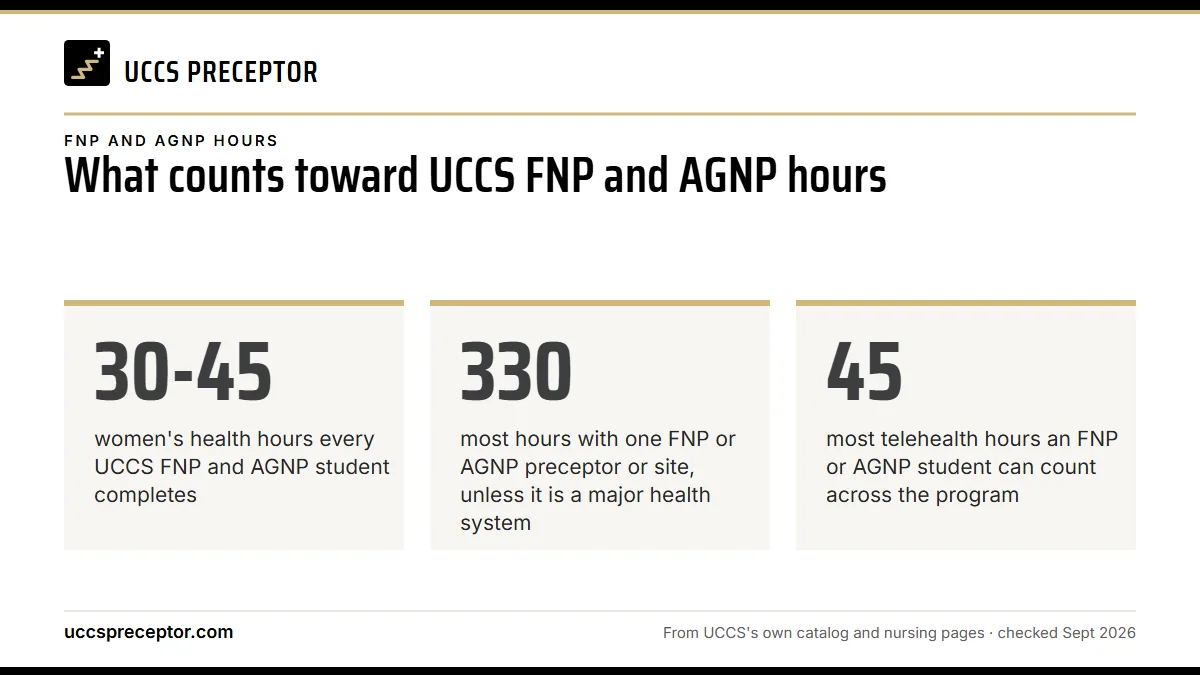
Most of the handbook's limits stop you from counting too much. Women's health also stops you from counting too little: at least 30 hours, and no more than 45. NURS 6960 Gender Health Primary Care is a 2-credit course with no listed hours of its own, so those hours come from your other rotations, and never from NURS 6900 pediatrics.
The practical fix is a preceptor whose regular schedule already includes well-woman visits, contraception and menopause care, whether in a family practice or a women's health clinic. Ask about that mix before your Clinical Site Sheet goes in, because a busy primary care office with few women's health visits can leave you short late in the program, when there is little room to add a new site.
Urgent care and specialty clinics come later
Urgent care opens from your second rotation onward, up to 110 hours across those rotations, and Synthesis allows up to 110 more, for 220 across the program. The 2024 handbook allowed 90 and 180, so older advice from classmates may quote the lower figures.
Specialty clinics count only in NURS 6980 Synthesis, up to 110 hours, and not at all in NURS 6982 Pre-Synthesis. The handbook names dermatology, orthopedics, interventional pain, outpatient palliative care, allergy and immunology, and cardiology; other specialties are decided case by case, and AGNP students may add adult pulmonology. The Synthesis practicum guide covers the final course in full.
NURS 6730 is stricter than any later course. Its 45 health assessment hours exclude urgent care, skilled nursing and specialty clinics as well as the emergency department, so your first preceptor needs to be squarely in primary care.
Telehealth, one preceptor, banking and campus hours
Four more limits run across the whole program rather than a single course, and two of them rose in the 08/2026 edition.
- Telehealth: 45 hours at most across the program, and only after you complete the tutorial the handbook requires.
- One preceptor or site: no more than 330 hours, up from 270 in the 2024 handbook, unless the site is a major health system.
- Banking: up to 55 hours in the program, up from 45 in the 2024 handbook, at your current site only and with coordinator approval, and they count only toward
NURS 6980. - Campus simulation: up to 20 extra hours in
NURS 6980from simulation or skills lab held on the UCCS campus. If you cannot travel, the Option Coordinator can discuss alternatives.
The 330-hour ceiling shapes your whole search. By simple arithmetic, a 630-hour student needs at least two preceptors or sites and a 770-hour student at least three, unless the major health system exception applies. Each rotation also calls for a different patient population, which tends to add preceptors rather than remove them.
Banked hours count only in NURS 6980, only with the coordinator's approval, and never beyond 55.
Where FNP and AGNP differ
The rules are shared, but the patients are not. FNP students need a pediatric primary care preceptor for NURS 6900 and are encouraged toward long-term care and hospice time in Synthesis. AGNP students take NURS 6950 geriatric primary care in place of pediatrics, and assisted living or skilled nursing hours can count there, up to 110.
That makes the AGNP search different in practice. A practice that follows patients into assisted living, or a skilled nursing provider, can host real AGNP hours, while the same site offers an FNP little until Synthesis. Urgent care, telehealth and single-preceptor limits are identical for both tracks, so the real difference is which clinics are worth approaching for each course. The geriatric rotation guide describes those settings, and both tracks share the preceptor rules on the FNP and AGNP preceptor page.
Why FNP and AGNP students choose us
We match you to preceptors by what their clinic actually sees, so the hours you log fit UCCS's rules for your course. Before introducing a preceptor, we confirm the setting is primary care, look at the women's health and urgent care mix against your caps, and plan enough preceptors across your program to stay under 330 hours with any one of them.
Then we assemble your site sheet information, a firm hour count against each preceptor's name, and get it to UCCS early so the Affiliation Agreement and preceptor letter can begin. UCCS decides on every placement; we make sure the sheet it receives already matches the FNP and AGNP rules. Contact us or use the form below.
Questions UCCS students ask
Do urgent care hours count for UCCS FNP students?
Yes, from the second rotation on. You can log up to 110 urgent care hours across your primary care rotations and up to 110 more in NURS 6980 Synthesis. Urgent care does not count in NURS 6730 or your first rotation, and an emergency department fast-track is not treated as urgent care at all.
Does telehealth count for UCCS AGNP hours?
A limited amount. FNP and AGNP students can count no more than 45 telehealth hours in the entire program, and only after finishing the tutorial the handbook requires. PMHNP students work under different telehealth rules, so advice from a psychiatric classmate does not carry over to your track.
Can I count hours at a dermatology or cardiology clinic?
Only in Synthesis. Both are on UCCS's named specialty list, and specialty time is capped at 110 hours in NURS 6980. Earlier rotations and NURS 6982 Pre-Synthesis cannot include specialty hours, so a dermatology preceptor is a Synthesis conversation, not a first-rotation one.
Can I stay with one preceptor for my whole UCCS program?
Not for all of it. The FNP/AGNP handbook caps time with one preceptor or site at 330 hours unless the site is a major health system. With 630 or 770 hours to complete, other preceptors will cover the rest, and the handbook also recommends that at least 200 of your hours be with a nurse practitioner.
Do hours at my own workplace count?
Only under set conditions. UCCS bars hours where you or a family member work, but your employer can host you at a different location or on a different floor or unit if the Graduate Clinical Practicum Coordinator approves. The workplace and family rules cover the details.
Related pages
Last checked 2026-09-25
We check these pages against UCCS's catalog, practicum handbooks and college pages. Your degree plan, the handbook for your cohort and the Graduate Clinical Practicum Coordinator have the final word.
UCCS asks you to find your clinical hours where you live. Let us run that search.
Tell us your UCCS track, your next clinical course and where you live. We find preceptors who fit the course and prepare the details your Clinical Site Sheet needs, early enough for the agreement to be signed before the semester.
- Preceptors matched to the course: pediatrics for
NURS 6900, acute and chronic care forNURS 6915andNURS 6925, psychiatric prescribers forNURS 6801toNURS 6803 - Credentials, license, certification and the site's signer ready for the Clinical Site Sheet
- In Colorado Springs, along the Front Range, or in any of UCCS's approved states
Start your placement plan
Your program, city and next clinical semester is all we need to begin.