What counts toward UCCS PMHNP hours
UCCS PMHNP hours can come from inpatient or outpatient psychiatric settings, and the handbooks encourage both. Telehealth counts when you sit with the provider in the office, a limited share of hours can be with licensed therapists, and before you graduate your Medatrax logs need 60 or more patients in each of three age groups: children and adolescents, adults, and older adults.
Find a psychiatric preceptor for your rotation
We match UCCS PMHNP students to psychiatric prescribers in their approved state, by rotation and population.
Inpatient and outpatient both count
PMHNP students are the one UCCS NP group allowed to log hours on inpatient units. The practicum handbooks go further than allowing it: students "are encouraged to have both inpatient and out-patient experiences." Group therapy, individual therapy, TMS and ECT are also named as experiences worth seeking.
One UCCS line reads differently. The MSN and certificate pages say the program is not intended to prepare students for emergency room or inpatient settings. For psychiatric rotations the PMHNP practicum handbook is the working rule, so if a site you propose is inpatient, mention it when the Clinical Site Sheet goes in and let the Graduate Clinical Practicum Coordinator, who answers questions about site suitability, confirm the fit.
For leads, the handbooks point to the Department of Corrections, to inpatient psychiatric hospitals and to community mental health clinics. Each can supply a different slice of the populations and treatment types your logs need.
Telehealth: count it from the office
Telehealth visits count for PMHNP students, which widens the range of practices that can host you. The handbook's expectation is that you are "with the provider in the office" during those visits. Joining remotely, from home or another location, needs the Option Coordinator's approval before those hours start.
State lines still apply to video care. UCCS says PMHNP students can use only providers in one of its approved states, even when telehealth is involved, so a psychiatrist who sees patients from a state off UCCS's list cannot host a virtual rotation for you. The approved states page lists where hours can happen.
This is one of the clearest differences from the primary care tracks. FNP and AGNP students face a 45-hour telehealth limit for the whole program; the PMHNP handbooks focus instead on where you sit and where the provider is licensed.
Therapy hours and who they can be with
Most PMHNP hours are spent with prescribers: psychiatric NPs, psychiatric clinical nurse specialists and psychiatrists, each holding full prescriptive authority and a license in the state that hosts your rotation. UCCS suggests you spend 200 or more of your hours with a PMHNP, the role you are training to fill.
A "limited number of hours" can be spent with an LCSW, a licensed counselor or a licensed psychologist, but only after the Option Coordinator agrees, and UCCS gives no fixed number. Get that approval in writing before the first session, and treat therapy time as a supplement to prescriber hours rather than a replacement.
Therapy experience itself is welcome with any approved preceptor: the handbooks encourage group and individual therapy. The full preceptor rules for this track are on PMHNP preceptor rules.
Your handbook sets your limits
PMHNP students follow one of two 08/2026 handbooks, chosen by start term. Beyond the hour totals, the two set different ceilings on time with one preceptor and different rules on banking.
| Rule | 630-hour handbook (began before Fall 2026) | 770-hour handbook (began Fall 2026 or later) |
|---|---|---|
NURS 6801, NURS 6802, NURS 6803 | 135 hours each | 165 hours each |
NURS 6985 Psych Mental Health Synthesis Practicum | 225 hours | 275 hours |
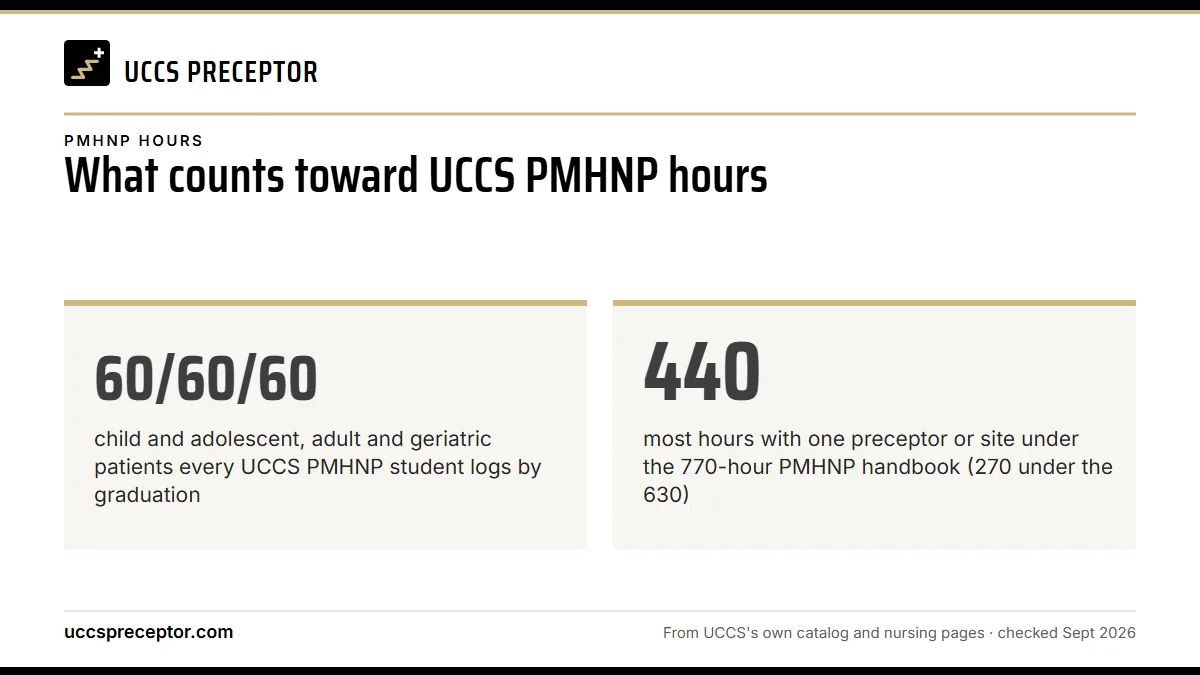
| Most hours with one preceptor or site | 270 | 440 |
| Banking | Not allowed: "Students cannot 'bank' hours" | Up to 55 hours |
The 770 edition also credits simulation work, capped at 10 hours, and conference attendance on psychopharmacology or therapy, which can add another 10 flexible hours. The reasons behind the two editions are on 630 vs 770 hours.
Under the 630-hour handbook there is no banking at all: surplus hours in one rotation stay in that rotation.
The 60/60/60 patient minimum
Hours alone do not finish the PMHNP track. Your logs also need a patient floor in three age bands, 60 apiece for children and adolescents, adults, and geriatric patients, reached by graduation. The rotations line up with those groups, NURS 6801 adult, NURS 6802 geriatric and NURS 6803 child and adolescent, and NURS 6985 Synthesis can fill any gap that remains.
Ask every prospective preceptor which ages they see. An adult outpatient practice can carry NURS 6801 comfortably yet add few children or older adults, so a mixed caseload for Synthesis can protect your totals. Every encounter is logged with ICD-10 and E/M codes plus fields for PMH encounter type, therapy and telehealth; the Medatrax logging guide explains them.
Course order matters too. NURS 6800 Mental Health Assessment comes first and carries no practicum hours, and NURS 6730 adds 45 hours only when it is on your degree plan.
Why PMHNP students choose us
Psychiatric preceptors who meet UCCS's rules take focused searching: full prescriptive authority, licensure in your rotation state, and a practice inside UCCS's approved-state list whether the visit is in person or by video. We run that search for you and match each rotation to its population, its inpatient or outpatient setting, and the in-office telehealth expectation.
Your site sheet information arrives from us complete, hours fixed for every preceptor, and goes in early so UCCS can draft the agreement and the preceptor's letter. When a preceptor cannot continue, your placement advisor goes straight back to the search. The final yes comes from UCCS, and we deliver a submission built to meet its rules on the first pass. Read more on psychiatric NP preceptors or use the form below.
Questions UCCS students ask
Can UCCS PMHNP students do hours on an inpatient psych unit?
Yes. The PMHNP practicum handbooks encourage both inpatient and outpatient experience, which sets this track apart from UCCS's FNP and AGNP tracks, where inpatient hours never count. Your preceptor still needs full prescriptive authority and a license in that state, and the site needs a signed Affiliation Agreement before your first hour.
Is there a telehealth hour limit for UCCS PMHNP students?
The 45-hour telehealth limit is written for FNP and AGNP students. The PMHNP handbooks set their conditions differently: you are expected to be in the office with the provider, remote participation needs Option Coordinator approval, and the provider must practice in one of UCCS's approved states.
Do TMS and ECT hours count for UCCS PMHNP?
Yes. The handbooks name TMS and ECT, along with group and individual therapy, as experiences students are encouraged to seek. They count like other psychiatric hours when your preceptor meets UCCS's rules, the site has a signed agreement and the time falls inside a registered semester after your "good to go" email.
When is the PMHNP site visit?
Plan on one phone call per clinical course from a UCCS site visitor, scheduled after the midpoint of that course's hours, and the call can happen without you on the line. Separately, any preceptor who logs over 24 clinical hours with you completes an evaluation that feeds your grade.
Which PMHNP rotation comes first?
NURS 6800 comes first and has no practicum hours; NURS 6801, NURS 6802 and NURS 6803 each require it, and your degree plan sets their order. Synthesis, NURS 6985, closes the track once the assessment course and the adult and geriatric rotations are complete, and an unfinished adult or geriatric rotation left as an incomplete keeps its door shut.
Related pages
Last checked 2026-09-25
We check these pages against UCCS's catalog, practicum handbooks and college pages. Your degree plan, the handbook for your cohort and the Graduate Clinical Practicum Coordinator have the final word.
UCCS asks you to find your clinical hours where you live. Let us run that search.
Tell us your UCCS track, your next clinical course and where you live. We find preceptors who fit the course and prepare the details your Clinical Site Sheet needs, early enough for the agreement to be signed before the semester.
- Preceptors matched to the course: pediatrics for
NURS 6900, acute and chronic care forNURS 6915andNURS 6925, psychiatric prescribers forNURS 6801toNURS 6803 - Credentials, license, certification and the site's signer ready for the Clinical Site Sheet
- In Colorado Springs, along the Front Range, or in any of UCCS's approved states
Start your placement plan
Your program, city and next clinical semester is all we need to begin.