UCCS PMHNP practicum courses, from NURS 6800 to Synthesis
UCCS's psychiatric track opens with an assessment course that carries no hours, moves through three population rotations (adult in NURS 6801, geriatric in NURS 6802, child and adolescent in NURS 6803) and closes with NURS 6985 Synthesis. Each rotation is 135 hours for anyone who began before Fall 2026 and 165 for Fall 2026 starts onward, and each one sends you looking for a psychiatric prescriber near home who treats that age group.
Get your placement plan
Tell us your UCCS program and where you live. A placement advisor replies with the preceptor and site options that fit your UCCS course.
Five courses, two hour columns
UCCS keeps two PMHNP practicum handbooks, each dated 08/2026: a 630-hour edition for anyone who began before Fall 2026 and a 770-hour edition for Fall 2026 starts onward. The course list matches across both. Only the hours move, and your start term picks the column.
| Course | Focus | Credits | Started before Fall 2026 | Started Fall 2026 or later |
|---|---|---|---|---|
NURS 6800 | Mental Health Assessment and Interventions Across the Lifespan | 3 | No practicum hours | No practicum hours |
NURS 6801 | Adult Psychiatric Diagnosis and Management for the PMHNP | 6 | 135 | 165 |
NURS 6802 | Geriatric Psychiatric Diagnosis and Management for the PMHNP | 6 | 135 | 165 |
NURS 6803 | Child and Adolescent Psychiatric Diagnosis and Management for the PMHNP | 6 | 135 | 165 |
NURS 6985 | Psych Mental Health Synthesis Practicum | 1-5 | 225 | 275 |
| Track total | All practicum courses | 630, plus 45 in NURS 6730 | 770, plus 45 in NURS 6730 |
The 45 Health Assessment hours sit outside both totals and apply to PMHNP students "if on your degree plan," which matters for certificate students whose GAP analysis may cover that course. Cohort questions belong to 630 vs 770 hours.
The sequence UCCS's catalog sets
UCCS publishes prerequisites rather than a semester-by-semester PMHNP plan. Read side by side, they produce a clear order, and the degree plan UCCS issues you on admission assigns each course a semester.
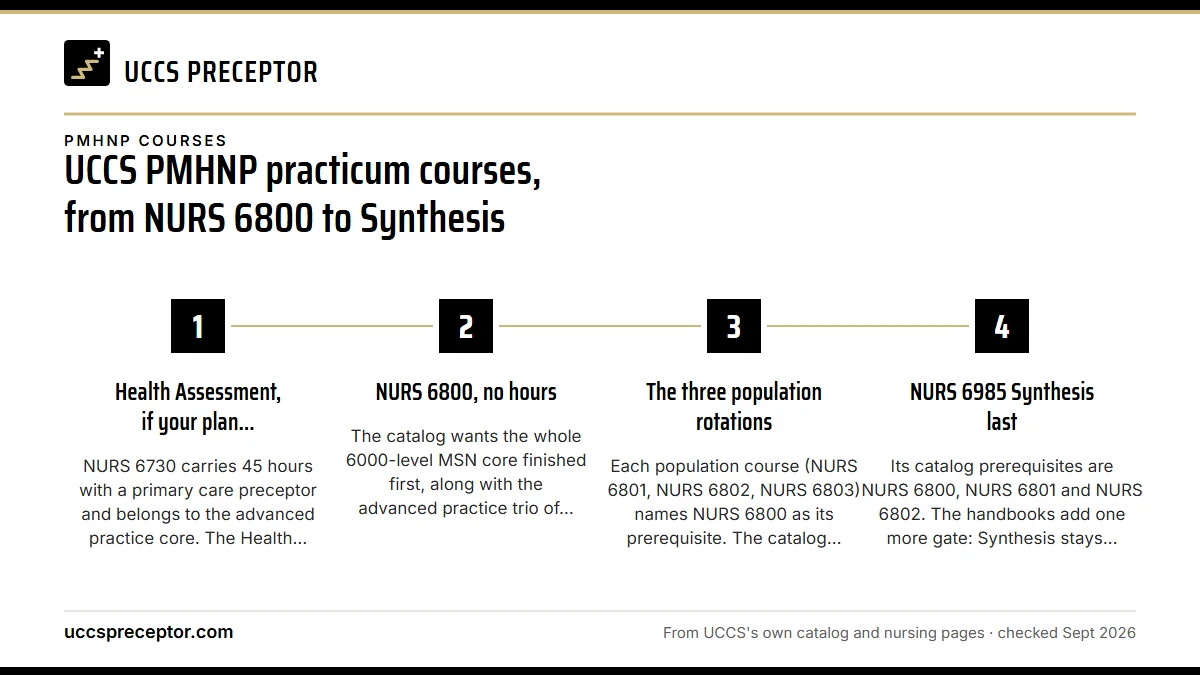
- Health Assessment, if your plan includes it
NURS 6730carries 45 hours with a primary care preceptor and belongs to the advanced practice core. The Health Assessment page covers it in full. - NURS 6800, no hoursThe catalog wants the whole 6000-level MSN core finished first, along with the advanced practice trio of
NURS 6280,NURS 6730andNURS 6740. With no hours attached, this is the semester to secure your first psychiatric preceptor. - The three population rotationsEach population course (
NURS 6801,NURS 6802,NURS 6803) namesNURS 6800as its prerequisite. The catalog does not rank them against one another, so the order comes from your degree plan. - NURS 6985 Synthesis lastIts catalog prerequisites are
NURS 6800,NURS 6801andNURS 6802. The handbooks add one more gate: Synthesis stays closed to anyone carrying an incomplete from the adult or geriatric rotation.
Since NURS 6803 is missing from the Synthesis prerequisite list, check where your degree plan places it before you ask a child and adolescent prescriber to hold a semester open for you.
Three populations, three searches
Each population course is built around one age band, so the preceptor behind it needs a steady flow of those patients. An adult outpatient psychiatry practice can carry NURS 6801 and still see few teenagers, while a child and adolescent service may see almost no older adults. Planning all three searches together keeps the later rotations from turning into a rush.
What each rotation points you toward
NURS 6801Adult: the broadest field. The PMHNP handbooks point to inpatient psychiatric hospitals, mental health clinics and the Department of Corrections, and they welcome a blend of inpatient and outpatient work.NURS 6802Geriatric: a psychiatric prescriber whose caseload includes a regular share of older adults. Ask about the age mix before the site sheet goes in, because it is what your logs will be measured on.NURS 6803Child and adolescent: a prescriber who treats children and teens every week. Start this search first if your degree plan puts the course soon afterNURS 6800.
By graduation the 770-hour handbook expects your logs to show at least 60 patients in each age band (child and adolescent, adult, geriatric), so a rotation that runs light in its own age group leaves a gap to close later. The counting rules, including therapy and telehealth encounters, live on what counts for PMHNP.
Rules that travel with every rotation
These handbook rules apply in all four practicum courses. Each has a fuller page of its own; the short version is enough to plan around.
- Your preceptor is a psychiatric NP, a psychiatric CNS or a psychiatrist, holds full prescriptive authority and is licensed in the state hosting your hours. Limited therapist hours and the finer points are on PMHNP preceptor rules.
- Telehealth counts when you sit in the office beside the provider. Working remotely on telehealth takes Option Coordinator approval, and the prescriber has to be located in a UCCS-approved state.
- Plan for a phone site visit in every clinical course; it comes after the halfway mark in your hours.
- Preceptors who log more than 24 hours with you rate your performance in Medatrax, and that rating feeds your grade.
- Every patient goes into Medatrax with ICD-10 and E/M codes, the PMH encounter type, and any therapy or telehealth entry.
NURS 6985, the Synthesis semester
Synthesis is the longest psychiatric block: 225 hours for the 630-hour cohort and 275 for the 770-hour cohort, listed at 1-5 credits in the catalog. It is also where several handbook exceptions come into play.
- Synthesis is exempt from the cap of three new agreements per semester, so extra sites can join here if your logs need a wider mix.
- Banked hours count only in the final synthesis course. The 770-hour handbook allows up to 55 banked hours; the 630-hour handbook allows none.
- The 770-hour handbook also credits up to 10 simulation hours, plus up to 10 "flexible" hours earned at a psychopharmacology or therapy conference.
- Any age group still short of 60 logged patients has to be filled before graduation, and Synthesis is the last course in which to do it.
The graduate grade rule still applies: a B (84%) or better, and a failed clinical portion means repeating the course together with its hours.
Paperwork behind each new rotation
Each new preceptor brings a full round of UCCS paperwork before the first hour counts, starting with a Clinical Site Sheet for each site and preceptor, every semester, with an exact hour figure. A new site also needs an Affiliation Agreement and a preceptor agreement letter, and a brand-new agreement may need 6 to 8 weeks, sometimes more if the legal review hits a snag.
Hours begin only after UCCS's "good to go" email. Outside Synthesis, a semester allows at most three new Affiliation Agreements, which matters when one rotation needs two preceptors to reach 165 hours. The mechanics are on the Clinical Site Sheet and Affiliation Agreement pages.
Only 16 hours with an unlisted preceptor can count, so get everyone you will work with onto a processed site sheet before the first shift.
Why PMHNP students choose us
We build each psychiatric search around the course you are about to enter. For NURS 6802 we look for a prescriber with a steady geriatric caseload; for NURS 6803, one who treats children and adolescents week in, week out; for Synthesis, a setting that fills whatever your logs still need. Every match is licensed in your home state.
Then we gather everything UCCS needs: your preceptor's credentials, license and prescriptive authority, the site's details, the name of whoever signs agreements for it, and the exact hours for your site sheet. Your file reaches the college complete and early, and UCCS gives the final approval. Should a preceptor pull out partway through a rotation, the placement desk begins lining up a replacement immediately. Tell us your next course with the form below, or read about finding PMHNP preceptors.
Questions UCCS students ask
Does NURS 6800 at UCCS include clinical hours?
No. Both PMHNP handbooks attach no practicum hours to NURS 6800, the lifespan mental health assessment course. It carries 3 credits and must come before all three population rotations, which makes it a sensible window to confirm the preceptor for your first psychiatric rotation and send the site sheet early.
Which PMHNP rotation comes first at UCCS: adult, geriatric or child?
The catalog lets each population course follow NURS 6800 and sets no order among the three. Your degree plan, issued at admission, assigns each one to a semester. If you want a different order, raise it early with the Academic Services Senior Professional who handles degree plans, since the Graduate Nursing Student Handbook caps requests at three without a written reason.
Can one psychiatric preceptor supervise all of my UCCS rotations?
Only up to a cap. One preceptor or site is limited to 270 hours in the 630-hour handbook, and the 770-hour edition raises that ceiling to 440. Anything beyond the cap needs another preceptor or site, and the handbooks also recommend spending at least 200 of your hours with a psychiatric NP.
Why does a UCCS handbook describe PMHNP hours as primary care?
The 08/2026 Preceptor Handbook says PMHNP students need 630 or 770 practicum hours "in primary care," while the PMHNP practicum handbooks encourage inpatient and outpatient psychiatric experience. The PMHNP handbooks are the documents written for your track. If a site raises the wording, the Graduate Clinical Practicum Coordinator can confirm how UCCS applies it.
How many hours a week does a UCCS PMHNP rotation take?
UCCS publishes no weekly figure. As plain arithmetic, 165 hours across a 16-week semester is a little over 10 hours a week, and 135 hours is under 9. Hours are valid only during a semester in which you are enrolled in the course, never before it starts or between terms, as the semester rules page explains.
Related pages
Last checked 2026-09-25
We check these pages against UCCS's catalog, practicum handbooks and college pages. Your degree plan, the handbook for your cohort and the Graduate Clinical Practicum Coordinator have the final word.
UCCS asks you to find your clinical hours where you live. Let us run that search.
Tell us your UCCS track, your next clinical course and where you live. We find preceptors who fit the course and prepare the details your Clinical Site Sheet needs, early enough for the agreement to be signed before the semester.
- Preceptors matched to the course: pediatrics for
NURS 6900, acute and chronic care forNURS 6915andNURS 6925, psychiatric prescribers forNURS 6801toNURS 6803 - Credentials, license, certification and the site's signer ready for the Clinical Site Sheet
- In Colorado Springs, along the Front Range, or in any of UCCS's approved states
Start your placement plan
Your program, city and next clinical semester is all we need to begin.