Finding psychiatric NP preceptors in UCCS's approved states
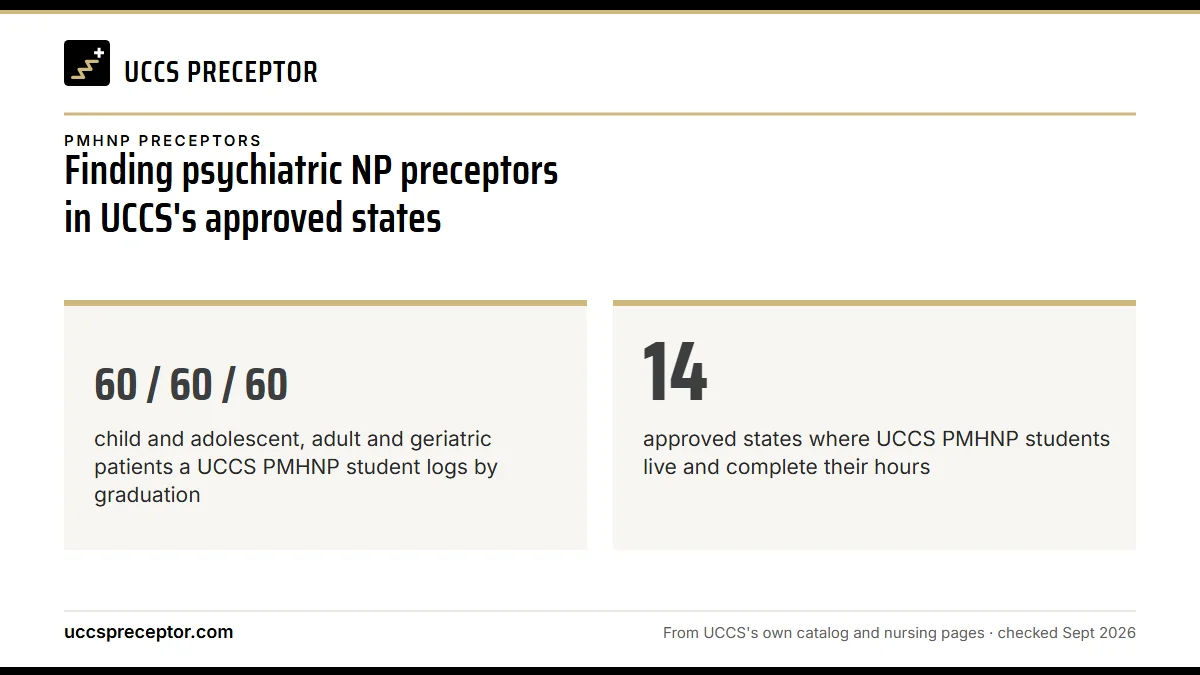
UCCS PMHNP students need psychiatric prescribers in the state where they live, with caseloads that cover adults, older adults and children across three population courses. That is a narrower search than primary care, and each of UCCS's 14 approved states shapes it a little differently. Here is who qualifies, where these prescribers work, how the populations steer the search, and what to check in your state.
Get your placement plan
Tell us your UCCS program and where you live. A placement advisor replies with the preceptor and site options that fit your UCCS course.
Who can precept you, in brief
UCCS's PMHNP handbooks accept three kinds of preceptor: psychiatric mental health nurse practitioners, psychiatric mental health clinical nurse specialists and psychiatrists. All three must prescribe with full authority, hold a license issued by your clinical state and bring two years of practice, and NPs also need national certification. UCCS suggests logging no fewer than 200 hours under a psychiatric NP.
Licensed clinical social workers, licensed counselors and psychologists can supervise only a limited share of your time, and only after the Option Coordinator approves it. Plan around prescribers and treat therapists as a supplement. The full rule set is on UCCS PMHNP preceptor rules.
Where psychiatric prescribers practice
Psychiatric prescribers work in more kinds of places than many students first search, and UCCS encourages both inpatient and outpatient experience. When you map your area, cover all of these:
- Inpatient psychiatric hospitals and the behavioral health units of larger health systems, a setting the handbooks name directly
- Community mental health centers and other mental health clinics, including those serving rural counties
- Outpatient psychiatric practices, from a single psychiatric NP to multi-prescriber groups
- Corrections health services, which the handbooks also suggest to PMHNP students
- Practices offering group and individual therapy, TMS or ECT, all of which UCCS encourages you to see
- Practices with a large telehealth panel, as long as you can sit in the office with the provider
Mixing inpatient and outpatient work across your courses matches the handbooks and widens your pool of prescribers.
Matching preceptors to the population courses
The PMHNP clinical sequence is sorted by patient group. NURS 6800 opens it without any practicum hours, and every counted hour falls in the adult, geriatric and child and adolescent courses and in Synthesis, in amounts tied to your start term. Order and prerequisites are on PMHNP practicum courses.
| Course | Hours: started before Fall 2026 | Hours: Fall 2026 or later | Caseload to look for |
|---|---|---|---|
NURS 6801 Adult | 135 | 165 | Adult psychiatric patients, inpatient or outpatient |
NURS 6802 Geriatric | 135 | 165 | A steady flow of older adult patients |
NURS 6803 Child and Adolescent | 135 | 165 | Children and teens under a prescriber who treats them regularly |
NURS 6985 Synthesis | 225 | 275 | A broad caseload that closes any gap in your patient minimums |
The match matters because your logs must reach the 60 / 60 / 60 patient minimums by graduation, and a practice that sees only adults cannot carry the child and adolescent course. One preceptor or site can supply at most 270 hours under the 630-hour handbook and 440 under the 770-hour handbook, so every PMHNP student works with more than one prescriber.
Inpatient, outpatient and telehealth rules
PMHNP students have more setting options than UCCS's primary care tracks. FNP and AGNP students may not log hospital or inpatient hours at all, while the PMHNP handbooks actively encourage inpatient experience alongside outpatient work.
Telehealth counts too, with a condition: UCCS expects you to sit beside the provider in the office while visits happen, and any remote arrangement, with the two of you in separate places, waits on the Option Coordinator's approval. The prescriber must also be based in an approved state even when every visit is by video, so a psychiatrist based outside that list cannot precept you remotely.
How telehealth encounters are coded, and what else counts toward your hours, is covered on what counts for PMHNP.
What changes from state to state
Your hours happen in the approved state where you live. Three state facts shape a psychiatric search there: the RN license you need, how the state regulates NP practice, and which large systems anchor care. The table uses NCSBN's compact map and AANP's practice classifications; the full list and program differences are on UCCS approved states.
| State | RN license for hours there | NP practice (AANP) | Large systems to check |
|---|---|---|---|
| Alaska | Alaska license | Full | Providence Alaska Medical Center, Alaska Native Medical Center |
| Arizona | Multistate license | Full | Banner Health, HonorHealth |
| California | California license | Restricted | Kaiser Permanente, University of California Health |
| Colorado | Multistate license | Full, after a 750-hour prescribing mentorship | UCHealth, CommonSpirit Health |
| Florida | Multistate license | Restricted | AdventHealth, UF Health |
| Idaho | Multistate license | Full | St. Luke's Health System, Saint Alphonsus Health System |
| Montana | Multistate license | Full | Billings Clinic, Logan Health |
| Nevada | Nevada license | Full, with early Schedule II limits | Renown Health, University Medical Center of Southern Nevada |
| New Mexico | Multistate license | Full | Presbyterian Healthcare Services, UNM Health System |
| Oklahoma | Multistate license | Restricted | OU Health, INTEGRIS Health |
| South Dakota | Multistate license | Full, after 1,040 collaborative hours | Sanford Health, Avera Health |
| Texas | Multistate license | Restricted | Baylor Scott & White Health, UT Southwestern Medical Center |
| Utah | Multistate license | Full | Intermountain Health, University of Utah Health |
| Wyoming | Multistate license | Full | Cheyenne Regional Medical Center, Banner Wyoming Medical Center |
Prescribing rules deserve a second look. In the four restricted states, many NPs prescribe under physician protocols, delegation or supervision, so ask the Option Coordinator whether a given psychiatric NP meets UCCS's full-prescriptive-authority rule, or look to psychiatrists. In Colorado, a newer APRN may hold provisional authority while finishing the mentorship; confirm your preceptor holds full authority. UCCS's handbook also notes that Denver Health may take students only from select universities. Colorado's rural preceptor tax credit, a state program, now reaches several behavioral health professions, as Colorado NP practice and preceptors explains.
Why PMHNP students choose us
Psychiatric placements reward thoroughness, and that is how we work. We search every psychiatric setting within your driving range, confirm each prescriber's role, license, certification and full prescriptive authority before you hear a name, and match the caseload to the course in front of you.
We also plan across the whole track: who can carry NURS 6801, who sees enough older adults for NURS 6802, where the child and adolescent rotation will come from, and how your handbook's same-preceptor cap shapes the sequence. You receive complete Clinical Site Sheet details for each rotation. The college decides on every site; we see to it that your PMHNP file arrives complete and matching the handbook. Tell us your state and course with the form below.
Questions UCCS students ask
Can a family nurse practitioner precept my PMHNP hours?
Not as your preceptor of record. UCCS's PMHNP handbooks name psychiatric mental health NPs, psychiatric CNSs and psychiatrists with full prescriptive authority. A family NP falls outside that list, even one who treats common mental health conditions in primary care. If a practice employs both, the psychiatric prescriber should be the one named on your site sheet.
How many different preceptors will a UCCS PMHNP student need?
More than one, by the numbers alone. The same-preceptor cap is 270 hours under the 630-hour handbook, which means at least three preceptors, and 440 under the 770-hour handbook, which means at least two. The population courses can add more when adults, older adults and children are seen in different practices near you.
Does UCCS count TMS or ECT experience?
Yes. UCCS's PMHNP handbooks list group and individual therapy, TMS and ECT among the experiences they want students to have. That time still sits inside a rotation supervised by an eligible psychiatric preceptor. If a practice you are considering offers TMS or ECT, ask how much of your time there the prescriber would supervise directly.
Is an inpatient psychiatric hospital a good PMHNP site?
It can be a strong one. The PMHNP handbooks encourage inpatient as well as outpatient experience and list inpatient psychiatric hospitals among the places to look. Check that the unit's patients fit the population course you are taking, and keep the same-site cap for your handbook in mind before planning a long block there.
Related pages
Last checked 2026-09-25
We check these pages against UCCS's catalog, practicum handbooks and college pages. Your degree plan, the handbook for your cohort and the Graduate Clinical Practicum Coordinator have the final word.
UCCS asks you to find your clinical hours where you live. Let us run that search.
Tell us your UCCS track, your next clinical course and where you live. We find preceptors who fit the course and prepare the details your Clinical Site Sheet needs, early enough for the agreement to be signed before the semester.
- Preceptors matched to the course: pediatrics for
NURS 6900, acute and chronic care forNURS 6915andNURS 6925, psychiatric prescribers forNURS 6801toNURS 6803 - Credentials, license, certification and the site's signer ready for the Clinical Site Sheet
- In Colorado Springs, along the Front Range, or in any of UCCS's approved states
Start your placement plan
Your program, city and next clinical semester is all we need to begin.