UCCS site visits and clinical evaluations
Expect one visit in every UCCS clinical course: FNP and AGNP visits happen in person or over the phone, PMHNP visits over the phone, and none is due until you reach the midpoint of the course's hours. Every preceptor who works with you past the 24-hour mark scores you in Medatrax on a four-point scale, and that score counts toward your grade.
Get your placement plan
Tell us your UCCS program and where you live. A placement advisor replies with the preceptor and site options that fit your UCCS course.
One site visit per course, after the halfway mark
UCCS checks on every clinical rotation once. The FNP/AGNP handbook tells students to "expect one on-site or phone visit during each clinical course," while the PMHNP handbooks describe a single phone visit per course. The Preceptor Handbook, written for all tracks, says "at least one site visit," by phone or on site, so treat one visit as the minimum.
| Source | Visit format | When it happens |
|---|---|---|
| FNP/AGNP Practicum Handbook (08/2026) | One visit, on site or by phone | Once you are at least halfway through the course's hours |
| PMHNP Practicum Handbooks (08/2026) | One visit, by phone | Once you are at least halfway through the course's hours |
| Preceptor Handbook (08/2026) | At least one, by phone or on site | Same halfway rule, per the Site Visitor Handbook |
Site visitors are university faculty or visitors UCCS contracts for the role. For a 110-hour course, the visit becomes due after your 55th hour; for a 165-hour PMHNP course, after about 83.
What the visit asks of you and your preceptor
For a phone visit, you do not need to be on the call. The Site Visitor Handbook says so directly, so the conversation can take place between the visitor and your preceptor alone. Your preceptor should expect the call and be ready to speak to how the rotation is going.
The visitor's evaluation counts toward your grade, just as the preceptor's does. That makes the visit worth preparing for, even though it is short. Keep your Medatrax logs current before the halfway point, and tell your preceptor when you are approaching it so the call does not land on a packed clinic day as a surprise.
Keep UCCS able to reach the right person. If your preceptor changes practices or schedules mid-semester, they need to tell you right away, and you should pass it on to the Graduate Clinical Practicum Coordinator so the visit and the evaluation still land with the preceptor who actually supervised you.
Preceptor evaluations in Medatrax
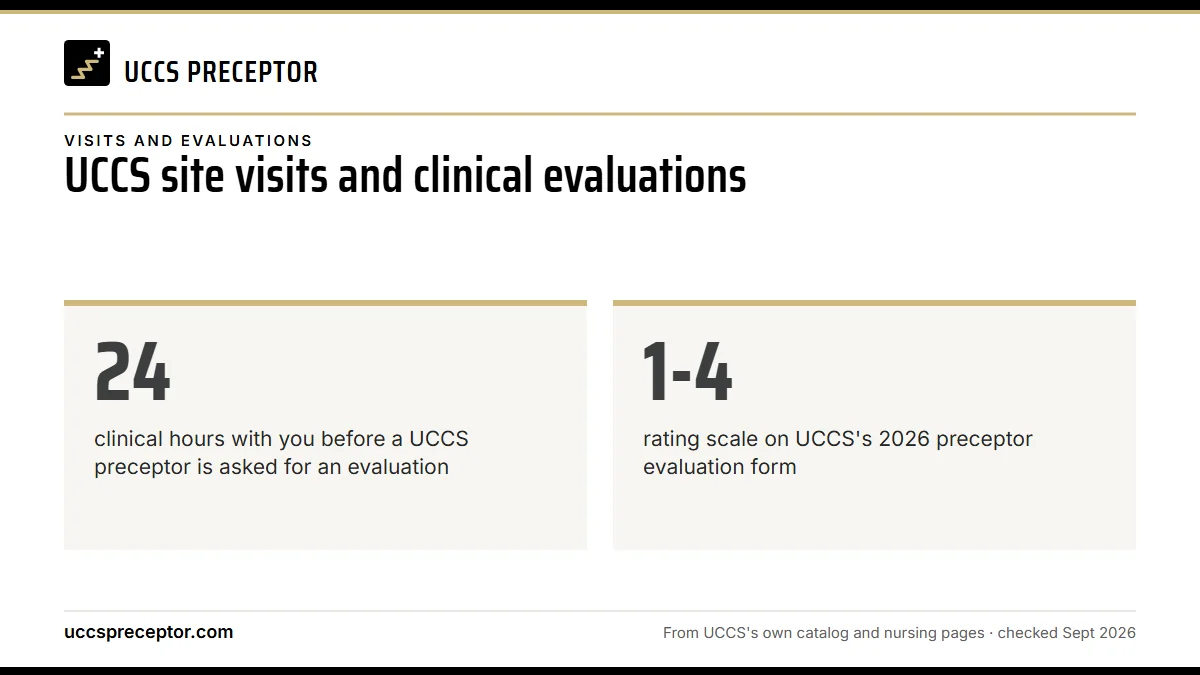
The trigger is hours, not the end of the rotation: "Preceptors who have been with a student for more than 24 clinical hours will be asked to fill out an evaluation form." If two preceptors each pass 24 hours with you in one course, both are asked. Someone you shadowed for a single shift is not.
The form lives in Medatrax, with a paper copy available on request. The Preceptor Handbook notes that "the same form is used for each level of student," so a first-rotation student and a Synthesis student are rated against the same descriptions. Ratings go from 1 (Needs significant improvement) up to 4 (Advanced), and N/O marks a skill the preceptor had no chance to observe.
Evaluations feed the course grade. A clinical failure sinks the entire course, and a repeat brings its clinical hours back with it. UCCS's B (84%) minimum and dismissal rules are on the grades and progression page.
Your preceptor's Medatrax evaluation is part of your grade, so make sure every preceptor past 24 hours knows the request is coming.
Your side: evaluations, a self-evaluation and logs
Evaluation runs in both directions. The FNP/AGNP handbook lists what students submit: an evaluation of the preceptor and site, a self-evaluation, and the clinical logs. All of it goes into Medatrax, which also holds the preceptor and site visitor forms.
Logs carry the most weight day to day. Each encounter is entered in Medatrax with your track's required codes, and UCCS ties faulty entries to an incomplete grade. The Medatrax logs page covers the codes and the encounter minimums for each course.
Complete your preceptor and site evaluation honestly and on time, and do the self-evaluation with the same care. Both are part of what the handbook expects you to submit for each course, alongside logs that match the hours your preceptor signs off on.
What UCCS sends your preceptor
Preceptors hear from UCCS mostly through Medatrax. The 08/2026 Preceptor Handbook describes a letter for each rotation level sent there, and it points preceptors who want more background to two national resources, NONPF's Preceptor Portal and AANP's knowledge center for preceptors.
UCCS's Preceptor Information page adds what preceptors receive in return: a semester record of the hours they supervised, which some certifying bodies credit toward recertification; use of the campus library once they ask for it; and contact with UCCS faculty. Preceptors weighing whether to take a student can read precept a UCCS student.
UCCS frames precepting as volunteer work. For clinicians practicing in rural or frontier Colorado, the college's preceptor page also points to a state tax credit program built for them; the state decides who qualifies, and the Colorado practice and preceptors page explains the mechanism.
Preceptors who are ready for UCCS's check-ins
When we line up a preceptor for you, we brief them on exactly what UCCS will ask during the semester: a site visit call once you pass the halfway mark, an evaluation in Medatrax after 24 hours together, and the 1 to 4 form used at every level. A preceptor who knows this in advance can plan for it, which helps the evaluation arrive on time.
We also stay on call through the rotation. If a preceptor's schedule changes before the visit or the evaluation, we are already working on your next step, and the preceptor falls through guide explains how UCCS handles a rotation that stops early. UCCS runs the visits and grades; we make sure the preceptor it contacts is prepared. Start with the form below.
Questions UCCS students ask
Do I have to be present for a UCCS phone site visit?
No. UCCS's Site Visitor Handbook says the student does not need to be present for a phone visit, so the visitor may speak with your preceptor alone. Let your preceptor know the call is coming once you pass the halfway point of your hours, and keep your Medatrax logs current before it.
When is the site visit in a UCCS clinical course?
Once you pass the midpoint of that course's hours. In a 110-hour primary care course that means after your 55th hour, and in a 165-hour PMHNP course after about 83. Visits are carried out by university faculty or by visitors UCCS contracts for the role.
Does every UCCS preceptor evaluate me?
Only preceptors past 24 clinical hours with you receive the request. If you split a course between two preceptors and both pass that mark, you get two evaluations. A provider you spent one short shift with is not asked, which is another reason to plan rotations around a main preceptor.
Can my preceptor fill out the UCCS evaluation on paper?
The standard route is Medatrax, but the Preceptor Handbook says a paper copy is available on request. The form is the same at every level of the program and uses a 1 to 4 scale plus N/O. Ask the Graduate Clinical Practicum Coordinator if your preceptor prefers paper.
Do site visits and evaluations affect my UCCS grade?
Yes. Both the preceptor's evaluation and the site visitor's evaluation count toward the course grade. A failed clinical component means a failed course, and retaking it means redoing the clinical hours too, so treat both as graded work rather than formalities.
Related pages
Last checked 2026-09-25
We check these pages against UCCS's catalog, practicum handbooks and college pages. Your degree plan, the handbook for your cohort and the Graduate Clinical Practicum Coordinator have the final word.
UCCS asks you to find your clinical hours where you live. Let us run that search.
Tell us your UCCS track, your next clinical course and where you live. We find preceptors who fit the course and prepare the details your Clinical Site Sheet needs, early enough for the agreement to be signed before the semester.
- Preceptors matched to the course: pediatrics for
NURS 6900, acute and chronic care forNURS 6915andNURS 6925, psychiatric prescribers forNURS 6801toNURS 6803 - Credentials, license, certification and the site's signer ready for the Clinical Site Sheet
- In Colorado Springs, along the Front Range, or in any of UCCS's approved states
Start your placement plan
Your program, city and next clinical semester is all we need to begin.