Moving during your UCCS program
UCCS ties you to the state that was home when you applied and reads residency as where you physically live. A move to another approved state means new approvals, a new preceptor and new agreements, while a move off the list can end clinical placement altogether. Plan the move around the program, not the reverse.
Get your placement plan
Tell us your UCCS program and where you live. A placement advisor replies with the preceptor and site options that fit your UCCS course.
What UCCS means by residency
The 08/2026 practicum handbooks put it in one line: "Residency is defined as physical location." They add that you "have been admitted to the UCCS program as a resident of the state in which you resided at the time of your application." Where you actually live is what counts.
That matters because UCCS ties its whole NP model to place. Coursework and clinical hours must happen inside the approved states, preceptors must be licensed where you do hours, and each Clinical Site Sheet names a site in a particular state. Change the place and every one of those pieces has to be checked again.
The handbooks are frank about the stakes. Before relocating, or before doing any practicum hours or online coursework in another state, students are told to check the approved-states list, because moving "may prohibit a student from completing their course of study or obtaining an NP license in a new state."
Three kinds of move
Not every move carries the same weight. Where you are going decides how much of your current plan survives the trip.
| Your move | What changes | Who to contact first |
|---|---|---|
| Within the same state | Your current site may fall out of reach, which means a new preceptor, a new Clinical Site Sheet and possibly a new Affiliation Agreement | The Academic Services Professional for Graduate Nursing, with the new site sheet |
| To another of the 14 approved states | Hours in the new state need approval, an RN license valid there and preceptors licensed there | The Graduate Clinical Practicum Coordinator |
| To a state not on the list | UCCS says students outside the listed states are not eligible for clinical placement, and didactic work must also be completed within the listed states | The Graduate Clinical Practicum Coordinator, before you move |
RN to BSN students check the 21-state list instead, and campus BSN students need to be living in Colorado. The approved states page sets out every list in full.
Before you move: a sequence that protects your semester
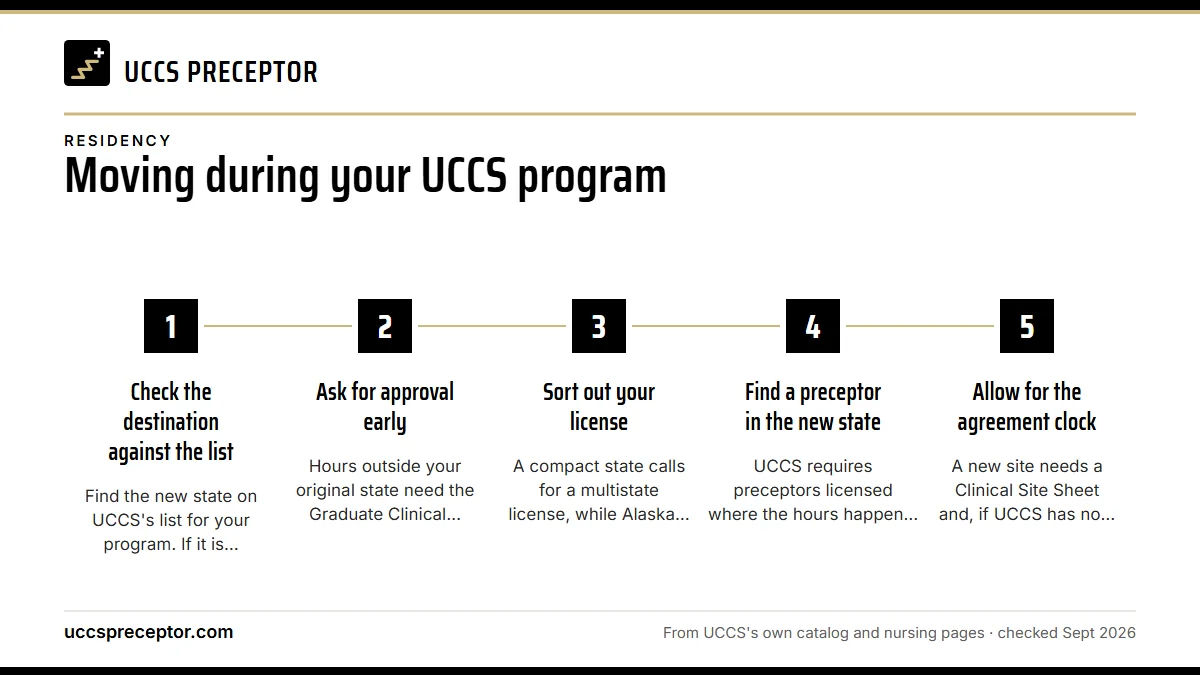
The earlier the college hears about a move, the more options stay open. Work through these steps while the move is still a plan.
- Check the destination against the listFind the new state on UCCS's list for your program. If it is missing, talk to the college before you sign a lease.
- Ask for approval earlyHours outside your original state need the Graduate Clinical Practicum Coordinator's approval. Ask as soon as the move looks likely, not after it happens.
- Sort out your licenseA compact state calls for a multistate license, while Alaska, California and Nevada each need their own RN license. State-by-state detail is in the license guide.
- Find a preceptor in the new stateUCCS requires preceptors licensed where the hours happen, so the next rotation needs someone licensed in the state you are moving to.
- Allow for the agreement clockA new site needs a Clinical Site Sheet and, if UCCS has no contract with it, an Affiliation Agreement whose legal review can run six to eight weeks, sometimes more. UCCS caps new agreements at three a semester, Synthesis excepted.
- Revisit your degree plan if the pace changesThe graduate handbook allows up to three degree plan requests without a written reason, and a move that slows you down is a sound reason to update yours.
Moving in the middle of a rotation
A mid-semester move is the hardest case. No hours count while paperwork for a new site is being processed, and time with a preceptor who is not on a processed site sheet stops counting after 16 hours. Leaving a preceptor partway through a course almost always opens a gap before the next site is cleared, and the Affiliation Agreement page explains why that gap can run for weeks.
If the move cuts a course short, an incomplete may be possible. It requires a passing grade in the didactic portion and a heads-up to both lead faculty and the Graduate Clinical Practicum Coordinator, and the missing hours are then completed the next term. Left unresolved for a calendar year, an incomplete turns into an F, and two of them block your next clinical course; the semester rules page has the details.
The cleaner path is to time the move for the break between semesters, when no hours can be done anyway, and to have the new site's paperwork moving before the boxes are packed.
Hold off on hours in a new state until the Coordinator has approved them and the "good to go" email has arrived; earlier hours will not be counted.
If the move means stepping away for a while
Some moves take a student off the list, or away from any workable site, for a stretch. The Graduate Nursing Student Handbook allows a leave of absence renewed semester by semester for up to three semesters, and a student out for more than one calendar year must reapply.
Coming back after a long gap brings a skills check. FNP and AGNP students who have been away more than two semesters must complete a head-to-toe assessment remediation; for PMHNP students, their handbook sets the threshold at three semesters. Keep the program time limits in view as well: six years for the MSN and seven for the DNPs. The grades and progression page covers those limits alongside the grade rules.
Licensure in the state you move to
A move usually changes where you will apply for your NP license, too, and UCCS's warning about licensure in a new state deserves attention. Look up the new state's row on UCCS's APRN licensure disclosure, which marks the curriculum as meeting educational requirements everywhere except Kansas, and then read that state's own board rules.
Keep the two documents apart. The disclosure does not make a state an approved place to live during the program. A student who moves to a state that shows "meets" on the disclosure but is missing from the 14-state list still faces the admission and placement rule.
Why students on the move choose us
A move is the moment a preceptor search turns urgent, and the search is the part UCCS leaves to you. Tell us the new address and the course you are heading into, and we start looking in the new state right away: preceptors licensed there, sites that fit your track's setting rules, and the person at each site who can sign an Affiliation Agreement.
We prepare the Clinical Site Sheet details early so the college can start its checks while you pack, and we stay on call if a new preceptor falls through. UCCS approves the out-of-state hours and every site; we make sure the paperwork reaching the college is complete. Reach us through the contact form.
Questions UCCS students ask
Can I move to another state during the UCCS FNP program?
You can move within UCCS's 14 approved states, but the Graduate Clinical Practicum Coordinator must sign off on hours there, and you need an RN license valid in that state and a preceptor licensed in it. A move to a state off the list is a different matter, since UCCS says students outside those states are not eligible for clinical placement. Talk to the college before committing.
Does UCCS go by my mailing address or where I actually live?
Where you physically live. The practicum handbooks define residency as physical location and count you as a resident of whichever state was home when you applied. If you split your time between two states, get the Graduate Clinical Practicum Coordinator's reading of your situation before planning hours in either one.
Will I need a new preceptor if I move within Colorado?
Often, if the move puts your current site out of reach. A new site means a new Clinical Site Sheet and, where UCCS has no contract yet, an Affiliation Agreement that can take weeks. The site sheet is renewed every semester anyway, so a move timed for the start of a term fits the normal cycle best.
Can I keep my current preceptor through telehealth after I move?
Rarely for a full rotation. FNP and AGNP students may count at most 45 telehealth hours across the whole program. PMHNP telehealth counts, but UCCS expects you in the office with the provider, requires Option Coordinator approval for remote work and limits providers to approved states. A move nearly always means finding a local preceptor.
What if the move leaves me needing more than three new agreements?
Outside the Synthesis courses, UCCS accepts at most three new Affiliation Agreements in a semester. When a preceptor cannot complete the hours, the handbook lets you put the circumstances in writing to three people, the Option Coordinator, the Graduate Clinical Practicum Coordinator and the Academic Services Professional, and ask to go past three.
Related pages
Last checked 2026-09-25
We check these pages against UCCS's catalog, practicum handbooks and college pages. Your degree plan, the handbook for your cohort and the Graduate Clinical Practicum Coordinator have the final word.
UCCS asks you to find your clinical hours where you live. Let us run that search.
Tell us your UCCS track, your next clinical course and where you live. We find preceptors who fit the course and prepare the details your Clinical Site Sheet needs, early enough for the agreement to be signed before the semester.
- Preceptors matched to the course: pediatrics for
NURS 6900, acute and chronic care forNURS 6915andNURS 6925, psychiatric prescribers forNURS 6801toNURS 6803 - Credentials, license, certification and the site's signer ready for the Clinical Site Sheet
- In Colorado Springs, along the Front Range, or in any of UCCS's approved states
Start your placement plan
Your program, city and next clinical semester is all we need to begin.