UCCS Traditional BSN: clinical seats, assigned rotations and what comes next
UCCS's Traditional BSN is an in-person, four-year program in Colorado Springs, and the college assigns its clinical rotations rather than asking students to find them. The real hurdle is earning a clinical seat, because limited facilities cap how many students can enter clinical courses. A placement service becomes useful later, once you move into a program where the preceptor search is yours.
Get your placement plan
Tell us your UCCS program and where you live. A placement advisor replies with the preceptor and site options that fit your UCCS course.
Earning a clinical seat
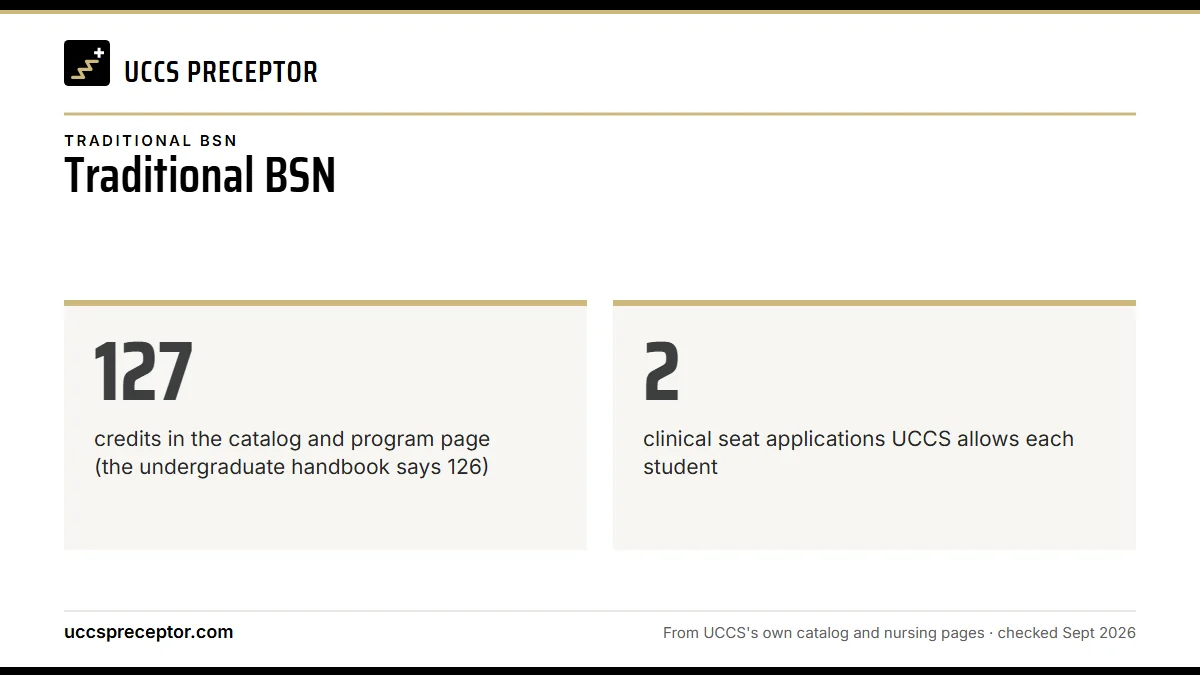
Clinical courses start in year two, and only after you win a clinical seat. The college asks for completed prerequisites with a 3.0 prerequisite GPA, the ATI TEAS, a background check and the BSN Clinical Application. You may apply only twice, so time your application for when your record is strongest.
The catalog is candid about why seats are scarce: limited clinical facilities in Colorado Springs restrict how many students can be accepted into clinical courses. Seats begin in fall (August) and spring (January). Applications for a fall seat run January 1 to March 1, and for a spring seat, September 1 to November 1.
The program is in person only. The program page accepts applicants who live in Colorado or intend to move there. Some UCCS online listings link to "Nursing, BSN", but the program page itself says on campus, so do not plan on completing it remotely.
Only two clinical seat applications are allowed, so a rushed first attempt uses up half of your chances.
Courses with clinical labs, year by year
Catalog descriptions label these courses "Theory and clinical laboratory", and the undergraduate handbook places them by year. Second-year courses must be finished before third-year courses, and third-year before fourth.
| Year | Course | Credits | Clinical note |
|---|---|---|---|
| Two | NURS 2100 Basic Health Assessment | 4 | Clinical practice lab |
| Two | NURS 2200 Fundamentals of Nursing Practice | 6 | Clinical component |
| Three | NURS 3100 Mental Health Nursing | 6 | Clinical laboratory |
| Three | NURS 3200 Nursing Care of Adults I | 6 | Acute care setting |
| Three | NURS 3210 Nursing Care of Adults II | 6 | Clinical laboratory |
| Four | NURS 4100 Nursing Care of Children | 6 | Clinical laboratory |
| Four | NURS 4200 Nursing Care of the Childbearing Family | 6 | Clinical laboratory |
| Four | NURS 4290 Medical/Surgical Nursing Capstone | 6 | Clinical laboratory |
| Four | NURS 4400 Public Health Nursing: Population Focused Care | 6 | Description does not say clinical |
UCCS publishes no hour count for any of these courses. The catalog's required-course list also omits NURS 1010 Pharmacological Math and NURS 2050 Pharmacology, which the handbook's year-two list includes; follow your advisor's plan where the two differ.
How UCCS assigns clinical rotations
Traditional BSN students do not source their own clinical sites. The undergraduate handbook refers to the facility or agency where a student is assigned for each rotation, and two roles run that system: the Undergraduate Clinical Placement Coordinator and the Clinical Facilities Coordinator. Because placement slots are limited, the handbook describes a prioritization system for allocating them.
Your part is compliance. Documents go into myClinicalExchange by August 1 for fall and December 1 for spring, and UCCS warns that a student who misses the first compliance deadline may lose a clinical placement. Behind the scenes, the Clinical Facilities Coordinator requests student EHR computer codes from hospitals 45 days before the semester. The immunizations and compliance page lists what to upload.
If a site falls through, the college looks for an alternative itself, while noting that an alternative is not always available.
Attendance, grades and progression
Clinical time carries its own failure rules. Under the Clinical Attendance Policy approved in December 2024, missing more than two clinical days is an automatic clinical failure: more than 14 hours in courses with 6 to 7 hour days, or more than 24 hours in courses with 12-hour days. Any make-up day has to be pre-approved by the community partner hosting the rotation.
A clinical failure fails the entire course. Required nursing courses need a C (74%) or better, and one failure in a required, non-elective nursing course of 3 credits or more stops your progression, subject to a single appeal to the Admissions and Progressions Committee.
Marijuana use of any kind, recreational or medicinal, is prohibited for nursing students, and a CastleBranch drug screen is among the undergraduate compliance requirements. Treat both the attendance and the conduct rules as seriously as exams.
Clinical electives
Four elective practicums sit alongside the required sequence: NURS 2990 Basic Clinical Practicum (1 credit), NURS 3990 Clinical Practicum (1 credit), NURS 4120 Perioperative Nursing Practicum (2 credits) and NURS 4590 Advanced Practicum: Clinical (2 credits). In 2026, NURS 2990 and NURS 3990 ran as pre-term intensives from August 10 to 21.
UCCS's public pages do not say how elective placements are arranged, so ask your Option Coordinator or nursing advisor before you assume either way. If the course faculty invite you to propose a setting, especially for the advanced practicum, that is the one point in the Traditional BSN where a targeted search can help, and your placement advisor can look for a unit or clinic that matches the interest you want to build.
Where our help fits for Traditional BSN students
Since UCCS assigns your required rotations, our role begins at the next step. If you are weighing the campus BSN against an associate degree followed by UCCS's online RN to BSN, know that the second route includes NURS 4450, a public health course whose community site you secure yourself, and that is a search we run from start to finish.
Our biggest role for campus BSN graduates comes when they head into nurse practitioner study. UCCS's MSN Family NP and BSN to DNP tracks expect students to find their own clinical hours where they live, and the application essay asks how you will secure sites. Your placement advisor can map the preceptors available in your part of Colorado before you apply, then search for, vet and prepare the paperwork for each rotation once you are admitted. Colorado is one of the 14 states UCCS's graduate NP programs accept, so staying in the state keeps every UCCS NP track open; check that list before any move.
UCCS approves every graduate site; we make sure what reaches the college is complete and follows its rules from the start. The finding your own preceptor guide explains that graduate expectation in full.
Questions UCCS students ask
Do UCCS Traditional BSN students find their own clinical placements?
No. UCCS assigns clinical rotations for the campus BSN through its Undergraduate Clinical Placement Coordinator and Clinical Facilities Coordinator, using a prioritization system because slots are limited. Your responsibilities are the compliance documents in myClinicalExchange, attendance and performance. Student-found placements begin at the graduate level and in the online RN to BSN.
How competitive is a UCCS BSN clinical seat?
UCCS publishes no acceptance rate, but the catalog says limited clinical facilities in Colorado Springs restrict how many students enter clinical courses. You need finished prerequisites with a 3.0 prerequisite GPA, the ATI TEAS, a background check and the clinical application, and you may apply only twice.
How many clinical hours are in each UCCS BSN course?
UCCS does not publish per-course clinical hours for the Traditional BSN. The catalog marks which courses include clinical laboratory, and the attendance policy implies both 6 to 7 hour and 12-hour clinical days. Your course syllabus and clinical instructor give the exact schedule for each rotation.
Can I take the UCCS Traditional BSN online?
No. The program page describes an in-person program for applicants living in Colorado or planning to move there. Some UCCS online listings link to the BSN, which causes confusion, but the program itself is campus based. Licensed RNs looking for an online option should look at the RN to BSN instead.
What happens if I miss a clinical day in the UCCS BSN?
Make-up days must be pre-approved by the community partner hosting the rotation. Missing more than two clinical days, which means more than 14 hours in 6 to 7 hour day courses or more than 24 hours in 12-hour day courses, is an automatic clinical failure, and a clinical failure fails the whole course.
Related pages
Last checked 2026-09-25
We check these pages against UCCS's catalog, practicum handbooks and college pages. Your degree plan, the handbook for your cohort and the Graduate Clinical Practicum Coordinator have the final word.
UCCS asks you to find your clinical hours where you live. Let us run that search.
Tell us your UCCS track, your next clinical course and where you live. We find preceptors who fit the course and prepare the details your Clinical Site Sheet needs, early enough for the agreement to be signed before the semester.
- Preceptors matched to the course: pediatrics for
NURS 6900, acute and chronic care forNURS 6915andNURS 6925, psychiatric prescribers forNURS 6801toNURS 6803 - Credentials, license, certification and the site's signer ready for the Clinical Site Sheet
- In Colorado Springs, along the Front Range, or in any of UCCS's approved states
Start your placement plan
Your program, city and next clinical semester is all we need to begin.